
 TR
TR Land Rover P2002 Fault Code: DPF Efficiency Below Threshold – Causes, Symptoms & Solutions
The Land Rover P2002 fault code indicates that the Diesel Particulate Filter (DPF) is operating below its expected efficiency. This guide explains the causes, symptoms, diagnostic procedures, and professional repair solutions for P2002 faults.
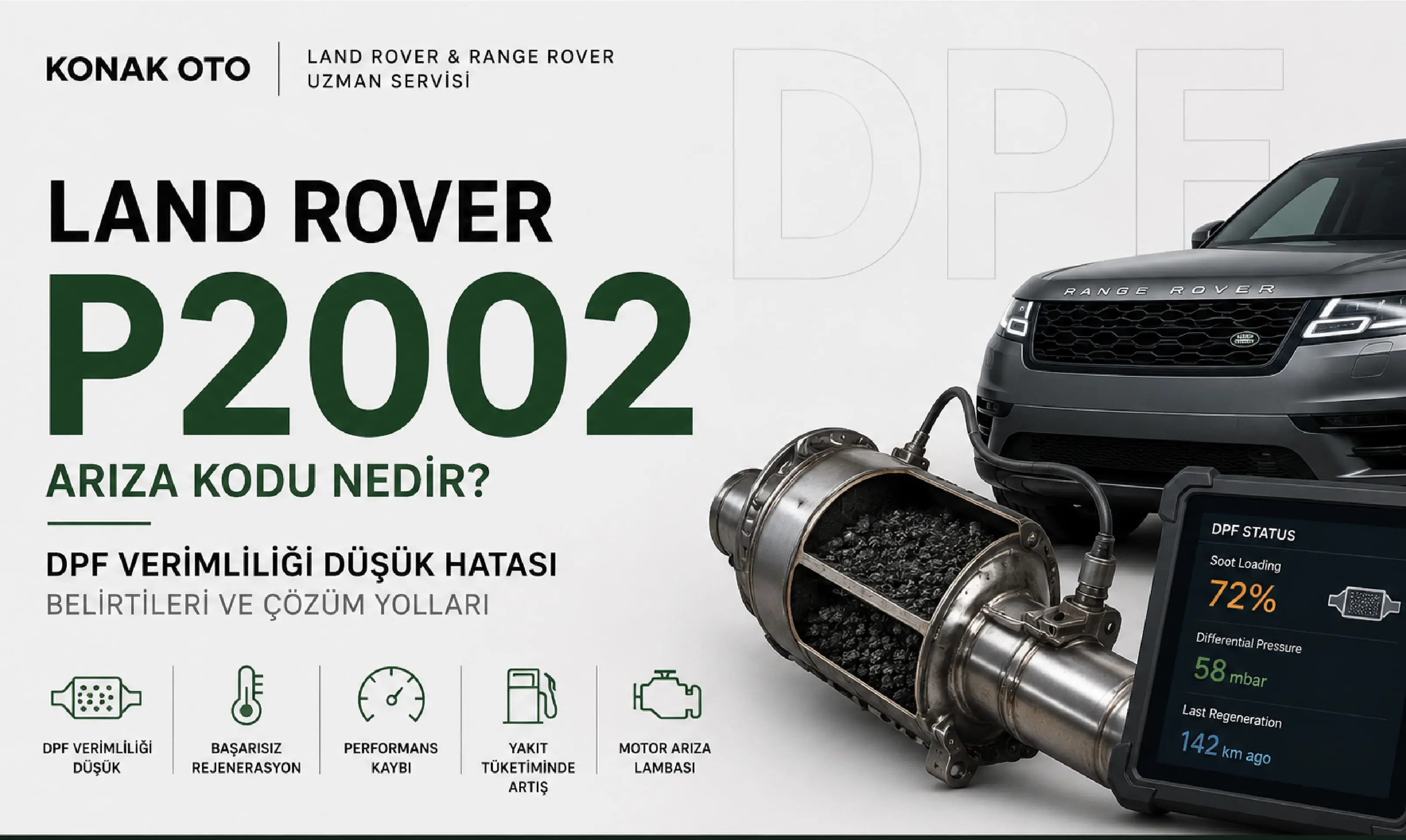
The Land Rover P2002 fault code indicates that the Engine Control Unit (ECU) has detected that the Diesel Particulate Filter (DPF) is operating below the required efficiency threshold. While a clogged DPF is a common cause, regeneration failures, differential pressure sensor faults, exhaust leaks, and engine performance issues may also trigger this fault. Accurate diagnosis requires professional analysis of the entire emission system.
Table of Contents
- What Does the P2002 Fault Code Mean?
- What Is a Diesel Particulate Filter (DPF)?
- Symptoms of the P2002 Fault Code
- What Causes the P2002 Fault Code?
- How Is the P2002 Fault Diagnosed?
- What Happens If the Fault Is Ignored?
- How Can You Prevent P2002?
- Professional Diagnostics at Konak Oto
- Conclusion
- Frequently Asked Questions
Land Rover P2002 Fault Code: DPF Efficiency Below Threshold – Causes, Symptoms & Solutions
The Diesel Particulate Filter (DPF) is one of the most important components of the emission control system in modern diesel-powered Land Rover and Range Rover vehicles.
Its primary function is to capture soot particles generated during combustion and reduce harmful exhaust emissions.
The Engine Control Unit (ECU) continuously monitors the efficiency of the DPF. When it determines that the filter is no longer operating within the expected efficiency range, it stores the P2002 Diagnostic Trouble Code (DTC) and typically illuminates the Check Engine Light.
However, contrary to popular belief, the P2002 fault code does not always mean that the DPF is completely clogged or requires replacement.
This fault may be caused by:
- Excessive soot accumulation inside the DPF
- Failed regeneration cycles
- Differential pressure sensor faults
- Exhaust system leaks
- Exhaust gas temperature sensor failures
- Turbocharger performance issues
- EGR system faults
- Fuel system or combustion-related problems
For this reason, simply clearing the fault code or replacing the DPF without proper diagnosis rarely provides a permanent solution.
In this guide, we explain what the Land Rover P2002 fault code means, its symptoms, possible causes, professional diagnostic procedures, and effective repair solutions.
What Does the P2002 Fault Code Mean?
P2002 is a generic OBD-II Diagnostic Trouble Code defined as:
"Diesel Particulate Filter Efficiency Below Threshold (Bank 1)"
In simple terms, the Engine Control Unit has detected that the Diesel Particulate Filter is no longer filtering soot particles at the required efficiency level.
The ECU continuously evaluates DPF performance using data from:
- Differential pressure sensor
- Exhaust gas temperature sensors
- Engine load
- Regeneration history
- Air-fuel ratio
- Engine operating conditions
When these values indicate that the DPF efficiency has fallen below the programmed threshold, the ECU stores the P2002 fault code.
It is important to remember that P2002 does not automatically indicate that the DPF must be replaced.
Information Box
P2002 Is a Result Code
The P2002 fault may be caused by:
- Excessive soot accumulation
- Failed DPF regeneration
- Differential pressure sensor failure
- Exhaust leaks
- EGR system faults
- Turbocharger issues
- Fuel injector problems
- Exhaust temperature sensor faults
- Excessive soot production caused by engine problems
Replacing or cleaning the DPF without identifying the underlying cause may result in the fault returning shortly afterward.
What Is a Diesel Particulate Filter (DPF)?
The Diesel Particulate Filter (DPF) is an emission control device installed in diesel-powered Land Rover vehicles.
Its purpose is to trap soot particles produced during combustion before they are released into the atmosphere.
As soot accumulates inside the filter, the ECU periodically initiates a regeneration process to burn off the stored particles.
During regeneration:
- Exhaust gas temperature increases.
- Soot particles are burned into ash.
- The filter's efficiency is restored.
When regeneration occurs successfully and regularly, the DPF can operate efficiently for many years.
How Does DPF Regeneration Work?
Land Rover vehicles generally use two types of regeneration.
Passive Regeneration
During extended highway driving, exhaust temperatures naturally become high enough to burn soot continuously.
Active Regeneration
When passive regeneration is insufficient, the ECU initiates active regeneration by:
- Injecting additional fuel
- Raising exhaust temperature
- Burning accumulated soot inside the DPF
Repeated interruption of active regeneration can eventually trigger the P2002 fault code.
Symptoms of the Land Rover P2002 Fault Code
Common symptoms include:
- Check Engine Light
- Reduced engine performance
- Poor throttle response
- Increased fuel consumption
- Frequent regeneration cycles
- Strong exhaust odor
- Reduced turbo performance
- Limp Mode activation
- Increased exhaust back pressure
Symptoms may vary depending on the severity of the restriction.
Reduced Engine Performance
A restricted DPF limits exhaust flow, making it more difficult for the engine to expel exhaust gases.
This may result in:
- Poor acceleration
- Reduced power
- Turbo lag
Increased Fuel Consumption
Frequent regeneration cycles require additional fuel injection.
Vehicles driven mainly in urban conditions often experience noticeably higher fuel consumption.
Limp Mode
When DPF restriction becomes critical, the ECU may activate Limp Mode to protect the engine.
The vehicle may experience:
- Limited RPM
- Restricted acceleration
- Reduced maximum speed
What Causes the P2002 Fault Code?
Several conditions can trigger the P2002 fault.
Excessive Soot Accumulation
The most common cause is excessive soot buildup inside the DPF.
This frequently occurs in vehicles driven primarily on short trips.
Failed Regeneration
Repeatedly interrupted regeneration cycles gradually increase soot accumulation until DPF efficiency falls below the ECU threshold.
Differential Pressure Sensor Failure
The differential pressure sensor measures exhaust pressure before and after the DPF.
Incorrect readings may cause the ECU to falsely detect poor DPF efficiency.
Exhaust System Leaks
Leaks before or near the DPF may affect pressure readings and trigger inaccurate efficiency calculations.
EGR System Problems
A malfunctioning EGR valve can increase soot production, causing the DPF to clog more rapidly.
Turbocharger or Fuel Injector Problems
Poor combustion caused by turbocharger faults or injector issues increases soot production and accelerates DPF loading.
Expert Insight
In Land Rover vehicles, the P2002 fault should never be diagnosed by evaluating the DPF alone.
A complete inspection should include the differential pressure sensor, exhaust temperature sensors, EGR system, turbocharger performance, fuel injectors, and regeneration history to identify the true root cause.
How Is the P2002 Fault Diagnosed?
Reading the fault code alone is not sufficient.
Professional diagnosis should include:
- Reading Diagnostic Trouble Codes (DTCs)
- Freeze Frame analysis
- DPF soot loading measurement
- Regeneration history review
- Differential pressure sensor testing
- Exhaust gas temperature sensor inspection
- Turbocharger performance evaluation
- EGR system inspection
- Fuel injector correction analysis
- Exhaust leak inspection
Only a comprehensive diagnostic process can accurately identify the underlying cause.
Freeze Frame Analysis
The ECU stores operating conditions when the fault occurs, including:
- Engine RPM
- Vehicle speed
- Engine load
- Exhaust gas temperature
- DPF differential pressure
- Fuel injection values
- Coolant temperature
These values help technicians determine the circumstances under which the fault developed.
Live Data Analysis
Live diagnostic data typically includes:
- DPF soot loading
- Differential pressure values
- Exhaust gas temperatures
- Last regeneration event
- Active regeneration status
- Turbo boost pressure
- Mass Air Flow (MAF) readings
These values help determine whether the DPF is actually restricted or if another system is responsible.
Information Box
Does P2002 Always Require DPF Replacement?
No.
Many P2002 faults are caused by:
- Failed regeneration
- Differential pressure sensor faults
- Exhaust leaks
- EGR system failures
- Turbocharger problems
- MAF sensor faults
- Fuel injector issues
Replacing the DPF without diagnosing the root cause often results in the fault returning.
What Happens If the P2002 Fault Is Ignored?
Ignoring the P2002 fault may eventually cause:
- Increased exhaust restriction
- Reduced engine performance
- Higher fuel consumption
- Turbocharger stress
- Failed regeneration cycles
- Limp Mode activation
- Complete DPF blockage
In severe cases, professional DPF cleaning or replacement may become necessary.
How Can You Prevent the P2002 Fault?
You can reduce the likelihood of P2002 by:
- Following scheduled maintenance
- Using the correct engine oil
- Allowing regeneration cycles to complete
- Driving long enough to reach normal operating temperature
- Responding promptly to Check Engine Lights
Proper maintenance significantly extends DPF life.
Professional P2002 Diagnostics at Konak Oto
At Konak Oto, the P2002 fault is never diagnosed based solely on DPF loading.
Our technicians perform:
- Complete electronic diagnostics
- Live DPF data analysis
- Differential pressure sensor testing
- Exhaust temperature sensor inspection
- Regeneration history evaluation
- EGR system diagnostics
- Turbocharger and intake system analysis
- Exhaust leak inspection
- Controlled regeneration or professional DPF cleaning when necessary
This comprehensive diagnostic approach ensures that both the fault code and its underlying cause are properly addressed.
Experience Matters
Since 1996, Konak Oto has specialised exclusively in Land Rover and Range Rover vehicles.
Permanent repair of the P2002 fault requires identifying not only the DPF condition but also the underlying reason for excessive soot production.
Conclusion
The Land Rover P2002 Diagnostic Trouble Code indicates that the Diesel Particulate Filter is operating below its required efficiency threshold.
However, the DPF itself is not always the source of the problem. Failed regeneration, differential pressure sensor faults, exhaust leaks, EGR malfunctions, or excessive soot production caused by engine issues may all trigger the same fault.
Accurate diagnosis requires analysing live diagnostic data, sensor readings, regeneration history, and the complete emission system.
Early diagnosis helps extend DPF life, improve engine performance, and prevent expensive repairs.
Frequently Asked Questions
Can I drive with a P2002 fault code?
The vehicle may continue to operate, but prolonged driving can lead to complete DPF blockage and reduced engine performance. A professional inspection is recommended as soon as possible.
Does P2002 always mean the DPF must be replaced?
No. Failed regeneration, sensor faults, exhaust leaks, or EGR system problems can all trigger the same fault code.
Can the P2002 fault clear itself?
In minor soot accumulation cases, a successful regeneration cycle may resolve the issue. However, if the root cause remains, the fault code will usually return.
Will DPF cleaning fix the P2002 fault?
If soot accumulation is the only issue, professional DPF cleaning may resolve the fault. However, underlying engine or sensor problems must also be repaired.