
 TR
TR Land Rover P0420 Fault Code: Catalytic Converter Efficiency Below Threshold – Causes, Symptoms & Solutions
The Land Rover P0420 fault code indicates that the Engine Control Unit has detected catalytic converter efficiency below the manufacturer's specified threshold. The issue may be caused by the catalytic converter itself, oxygen sensors, exhaust leaks, or engine performance problems affecting emissions.
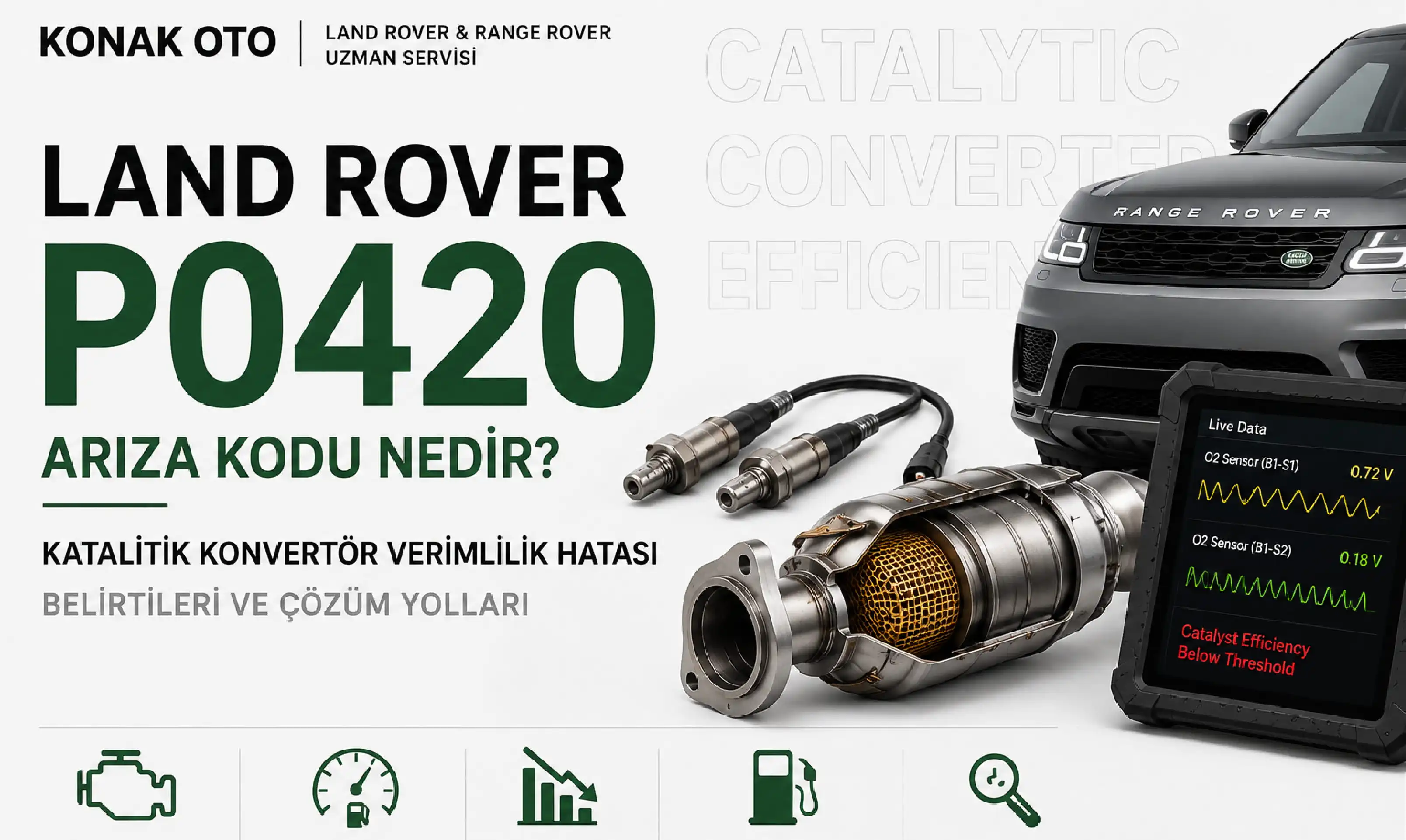
The Land Rover P0420 fault code means the Engine Control Unit has detected catalytic converter efficiency below the expected threshold. Although the catalytic converter is often suspected, oxygen sensor faults, exhaust leaks, incorrect air-fuel mixtures, ignition problems, and engine performance issues may also trigger this code. Professional diagnostics are essential for accurate repairs.
Table of Contents
- What Does the P0420 Fault Code Mean?
- How Does a Catalytic Converter Work?
- Symptoms of the Land Rover P0420 Fault
- What Causes the P0420 Fault Code?
- How Is the P0420 Fault Diagnosed?
- What Happens If the Fault Is Ignored?
- How Can P0420 Be Prevented?
- Professional Emission System Diagnostics at Konak Oto
- AI Summary
- Conclusion
- Frequently Asked Questions
Land Rover P0420 Fault Code: Catalytic Converter Efficiency Below Threshold – Causes, Symptoms & Solutions
The Land Rover P0420 fault code indicates that the Engine Control Unit (ECU) has determined that the catalytic converter is no longer operating at the efficiency level specified by the manufacturer. This OBD-II Diagnostic Trouble Code is commonly accompanied by the Check Engine Light and points to reduced performance within the vehicle's emission control system.
Modern Land Rover and Range Rover vehicles use advanced emission control technologies to minimise harmful exhaust gases. One of the most important components of this system is the catalytic converter, which converts harmful pollutants produced during combustion into less harmful gases before they leave the exhaust system.
The ECU continuously monitors catalytic converter efficiency by comparing data from the upstream and downstream oxygen sensors. If the difference between these sensor signals becomes smaller than expected, the ECU interprets this as reduced catalytic converter efficiency and stores the P0420 fault code.
Many vehicle owners assume that the catalytic converter itself has failed as soon as they see P0420. However, this is not always the case.
The fault may also be caused by:
- Oxygen sensor faults
- Exhaust leaks
- Incorrect air-fuel mixture
- Ignition system problems
- Fuel injector issues
- Rich or lean engine operation
- Engine performance faults affecting emissions
Simply replacing the catalytic converter without identifying the underlying cause often results in unnecessary expense and may not permanently solve the problem.
In this guide, you'll learn what the Land Rover P0420 fault code means, how the catalytic converter works, the most common symptoms, possible causes, professional diagnostic procedures, and the most effective repair solutions.
What Does the P0420 Fault Code Mean?
P0420 is a generic OBD-II Diagnostic Trouble Code defined as:
Catalyst System Efficiency Below Threshold (Bank 1)
In simple terms, this means that the ECU has detected that the catalytic converter on Bank 1 is no longer cleaning exhaust gases as efficiently as expected.
To make this assessment, the ECU continuously evaluates data from multiple systems, including:
- Upstream Oxygen Sensor
- Downstream Oxygen Sensor
- Air-Fuel Ratio
- Fuel Trim Values
- Engine Load
- Engine Speed
- Exhaust Gas Temperature
Under normal operating conditions, the upstream oxygen sensor signal fluctuates rapidly while the downstream sensor produces a much more stable signal.
If both sensors begin displaying similar switching patterns, the ECU determines that the catalytic converter is no longer effectively storing oxygen and converting harmful emissions.
It is important to understand that P0420 does not automatically mean the catalytic converter has failed. It simply indicates that the ECU has detected reduced emission system efficiency.
Information Box
P0420 Is a Result Code
The P0420 fault code may be related to:
- Catalytic Converter
- Upstream Oxygen Sensor
- Downstream Oxygen Sensor
- Exhaust System
- Exhaust Leaks
- ECU
- Ignition System
- Fuel Injectors
- Air-Fuel Mixture
- Fuel Trim Values
Replacing the catalytic converter before completing a full diagnostic inspection can lead to unnecessary repair costs while leaving the original fault unresolved.
How Does a Catalytic Converter Work?
The catalytic converter is one of the most important components of the exhaust emission control system in modern Land Rover and Range Rover vehicles. Its purpose is to reduce harmful exhaust emissions by converting toxic gases produced during combustion into environmentally safer compounds through chemical reactions.
As exhaust gases leave the engine, they pass through the catalytic converter before exiting the exhaust system.
Inside the converter is a ceramic or metallic honeycomb substrate coated with precious metals such as:
- Platinum
- Palladium
- Rhodium
These materials act as catalysts, accelerating chemical reactions without being consumed during the process.
The catalytic converter primarily converts:
- Carbon Monoxide (CO)
- Hydrocarbons (HC)
- Nitrogen Oxides (NOx)
into:
- Carbon Dioxide (CO₂)
- Nitrogen (N₂)
- Water Vapour (H₂O)
For maximum efficiency, the engine must operate with the correct air-fuel mixture while the ignition and fuel systems remain in proper working condition.
How Does the ECU Monitor the Catalytic Converter?
The Engine Control Unit (ECU) does not directly measure catalytic converter efficiency.
Instead, it continuously compares information from two oxygen sensors located in the exhaust system:
- Upstream Oxygen Sensor (Sensor 1)
- Downstream Oxygen Sensor (Sensor 2)
The upstream sensor measures the oxygen content in the exhaust gases immediately after combustion. This information helps the ECU adjust fuel delivery to maintain the ideal air-fuel ratio.
The downstream sensor monitors the gases leaving the catalytic converter.
A properly functioning catalytic converter stores oxygen and smooths the fluctuations in exhaust composition.
Therefore:
- The upstream oxygen sensor produces a rapidly changing voltage signal.
- The downstream oxygen sensor should produce a much more stable signal.
If the downstream sensor begins to mirror the switching pattern of the upstream sensor, the ECU determines that the catalytic converter is no longer storing oxygen effectively and may store the P0420 Diagnostic Trouble Code.
Why Does a Catalytic Converter Lose Efficiency?
Catalytic converters naturally lose efficiency as mileage increases.
However, in many cases the converter itself is not the original source of the problem.
Several engine-related issues can shorten catalytic converter life, including:
- Rich air-fuel mixtures
- Engine misfires
- Faulty fuel injectors
- Oil consumption
- Coolant entering the combustion chamber
- Long-term ignition problems
- Poor engine maintenance
When these conditions continue for extended periods, excessive heat or contamination can damage the internal catalyst substrate.
This is why diagnosing only the catalytic converter without evaluating the engine often leads to incorrect repairs.
Information Box
Can a Catalytic Converter Be Cleaned?
In certain situations, professional cleaning procedures may improve catalytic converter performance if efficiency loss is caused by carbon deposits.
However, cleaning cannot repair a converter if:
- The ceramic substrate has melted.
- The honeycomb structure has collapsed.
- The catalyst coating has deteriorated.
- The converter has suffered physical damage.
In these cases, replacement is usually the only permanent solution.
Symptoms of the Land Rover P0420 Fault
The P0420 fault code does not always produce obvious drivability problems.
Many Land Rover vehicles continue operating normally during the early stages, with the Check Engine Light being the only visible symptom.
As the underlying problem progresses, additional symptoms may appear.
Common symptoms include:
- Check Engine Light
- Increased fuel consumption
- Reduced engine performance
- Higher exhaust emissions
- Unusual exhaust odour
- Sluggish throttle response
- Failed emissions inspection
- Limp Mode (in severe cases)
The severity of these symptoms depends on the actual cause of the fault.
Check Engine Light
The most common symptom is illumination of the Check Engine Light.
Once the ECU detects catalytic converter efficiency below the acceptable threshold, it stores the P0420 fault code and alerts the driver.
Increased Fuel Consumption
Although the catalytic converter itself does not directly increase fuel consumption, the conditions that trigger the P0420 fault often do.
Problems such as:
- Incorrect air-fuel ratio
- Oxygen sensor faults
- Fuel injector issues
can all reduce combustion efficiency and increase fuel usage.
Reduced Engine Performance
If the catalytic converter becomes partially restricted, exhaust gases cannot flow freely.
This may result in:
- Reduced acceleration
- Poor high-speed performance
- Loss of engine power
- Increased turbo back pressure
Performance loss is usually more noticeable during heavy acceleration or climbing steep gradients.
Unpleasant Exhaust Odour
A catalytic converter that no longer functions efficiently may allow unprocessed exhaust gases to leave the exhaust system.
Drivers often notice a strong sulphur or rotten egg smell, particularly after prolonged driving or heavy engine load.
Failed Emissions Inspection
One of the most common real-world consequences of a P0420 fault is failure during emissions testing.
If catalytic converter efficiency falls below legal limits, the vehicle may fail mandatory emissions inspections until the underlying issue has been repaired.
Can You Continue Driving with a Land Rover P0420 Fault Code?
In many cases, the vehicle will remain drivable. However, the P0420 fault may indicate problems affecting the catalytic converter, oxygen sensors, fuel system, or combustion process. Continuing to drive without proper diagnosis can increase repair costs and reduce emission system efficiency. A professional inspection is recommended as soon as possible.
What Causes the Land Rover P0420 Fault Code?
The P0420 fault code does not automatically mean that the catalytic converter has failed. Instead, it indicates that the ECU has detected emission system efficiency below the manufacturer's expected threshold.
In many cases, the catalytic converter is only the result of another underlying engine or emission system problem.
For this reason, professional diagnostics should evaluate the entire emission control system rather than replacing the catalytic converter immediately.
Catalytic Converter Efficiency Loss
The most common cause of a P0420 fault is reduced catalytic converter efficiency.
Over time, continuous exposure to high exhaust temperatures and combustion by-products can reduce the converter's ability to process harmful gases.
As efficiency decreases:
- Oxygen storage capacity is reduced.
- Exhaust gases are cleaned less effectively.
- Upstream and downstream oxygen sensor signals become increasingly similar.
- The ECU determines that catalyst efficiency has fallen below the acceptable threshold.
Although this condition often develops gradually, prolonged engine problems can accelerate catalyst deterioration.
Faulty Oxygen Sensors
The ECU relies heavily on oxygen sensor feedback to evaluate catalytic converter performance.
The upstream oxygen sensor controls the air-fuel mixture.
The downstream oxygen sensor monitors catalyst efficiency.
If either sensor begins transmitting inaccurate information due to ageing, contamination, wiring faults, or internal failure, the ECU may incorrectly conclude that catalytic converter efficiency has decreased.
For this reason, oxygen sensor performance should always be verified before replacing the catalytic converter.
Exhaust System Leaks
Even a relatively small exhaust leak can introduce outside air into the exhaust stream.
This additional oxygen changes the readings reported by the oxygen sensors and may lead the ECU to incorrectly calculate catalyst efficiency.
Common leak locations include:
- Exhaust manifold gasket
- Flex pipe
- Exhaust flange connections
- Welded joints
- Exhaust pipe cracks
Repairing an exhaust leak may eliminate the P0420 fault without replacing any major components.
Incorrect Air-Fuel Mixture
The catalytic converter is designed to operate within a very narrow air-fuel ratio.
If the engine consistently runs too rich or too lean, combustion quality decreases and catalyst efficiency begins to suffer.
Possible causes include:
- Faulty MAF Sensor
- Faulty MAP Sensor
- Vacuum leaks
- Fuel injector problems
- Fuel pressure issues
Long-term mixture problems may permanently damage the catalytic converter.
Ignition System Problems
Engine misfires are particularly harmful to catalytic converters.
When combustion fails inside the cylinder, unburned fuel enters the exhaust system.
Inside the catalytic converter this fuel continues burning, generating excessive temperatures that may damage the ceramic substrate.
Common ignition-related causes include:
- Worn spark plugs
- Faulty ignition coils
- Ignition timing issues
- Cylinder misfires
If these faults remain unresolved, catalytic converter failure may eventually occur.
Fuel Injector Problems
Fuel injectors that leak or deliver incorrect fuel quantities can significantly affect combustion quality.
Possible injector faults include:
- Fuel leakage
- Poor spray pattern
- Incorrect fuel delivery
- Internal injector wear
These conditions increase exhaust emissions and place additional thermal stress on the catalytic converter.
MAF and MAP Sensor Problems
The ECU calculates fuel delivery based on airflow and intake pressure information.
If either the MAF or MAP sensor provides inaccurate data, the engine may operate with an incorrect air-fuel mixture.
This can result in:
- Higher emissions
- Reduced catalyst efficiency
- Increased fuel consumption
- P0420 fault storage
It is not unusual for P0420 to appear alongside fault codes such as P0101 or P0106.
ECU Calibration or Software Issues
Although uncommon, ECU software or calibration issues may occasionally contribute to incorrect catalyst efficiency calculations.
Some Land Rover models receive manufacturer software updates that improve catalyst monitoring strategies.
Professional diagnostics should therefore include verification of ECU software status whenever appropriate.
Expert Insight
Replacing the catalytic converter should never be the first repair performed after a P0420 fault code appears.
At Konak Oto, our diagnostic procedure begins by evaluating the complete emission control system.
This includes:
- Live oxygen sensor graphs
- Short and Long Fuel Trim values
- Exhaust leak inspection
- Ignition system evaluation
- Fuel injector performance
- MAF and MAP sensor data
- ECU adaptation values
- Catalyst operating behaviour
Only after analysing the complete system do we determine whether the catalytic converter itself has actually failed.
This approach prevents unnecessary replacement of one of the most expensive components in the exhaust system.
What Is the Most Common Cause of the Land Rover P0420 Fault Code?
The most common causes of the Land Rover P0420 fault code include catalytic converter efficiency loss, faulty oxygen sensors, exhaust leaks, incorrect air-fuel mixtures, ignition system faults, and fuel injector problems. Professional diagnostics are required because the catalytic converter is often the result of another engine-related issue rather than the original cause.
How Is the Land Rover P0420 Fault Diagnosed?
Accurately diagnosing the Land Rover P0420 fault code requires far more than simply reading the stored Diagnostic Trouble Code using an OBD-II scanner.
Because P0420 evaluates the overall efficiency of the emission control system, technicians must inspect the catalytic converter, oxygen sensors, engine operation, and exhaust system together.
A professional diagnostic procedure typically includes:
- Reading all stored Diagnostic Trouble Codes (DTCs)
- Reviewing Freeze Frame data
- Monitoring upstream and downstream oxygen sensor activity
- Analysing Short and Long Fuel Trim values
- Inspecting the exhaust system for leaks
- Measuring catalytic converter operating temperature
- Evaluating ignition system performance
- Checking MAF and MAP sensor data
- Inspecting fuel injector operation
- Reviewing ECU adaptation values
This structured diagnostic approach helps identify the true source of the fault before replacing expensive emission system components.
Why Is Freeze Frame Data Important?
Whenever the ECU stores the P0420 Diagnostic Trouble Code, it also records the operating conditions at the exact moment the fault occurred.
Freeze Frame data typically includes:
- Engine RPM
- Vehicle speed
- Engine load
- Coolant temperature
- Intake air temperature
- Fuel Trim values
- Oxygen sensor voltages
- Airflow readings
- Accelerator pedal position
These values help technicians determine whether the fault occurs:
- During cold starts
- At operating temperature
- Under heavy acceleration
- During motorway driving
- While idling
Understanding when the fault occurs greatly improves diagnostic accuracy.
Live Data Analysis
Live Data analysis is one of the most valuable diagnostic tools when investigating the P0420 fault.
Manufacturer-level diagnostic equipment allows technicians to monitor multiple parameters simultaneously, including:
- Upstream Oxygen Sensor Voltage
- Downstream Oxygen Sensor Voltage
- Short-Term Fuel Trim (STFT)
- Long-Term Fuel Trim (LTFT)
- Mass Air Flow (MAF)
- Manifold Absolute Pressure (MAP)
- Engine Load
- Catalyst Temperature (where available)
- Engine Coolant Temperature
Under normal operating conditions:
- The upstream oxygen sensor switches rapidly between rich and lean.
- The downstream oxygen sensor should produce a much smoother and more stable signal.
If the downstream sensor begins switching at a rate similar to the upstream sensor, catalyst efficiency has likely decreased.
Live Data analysis also helps determine whether the problem originates from the catalytic converter itself or from another engine management component.
Information Box
Does P0420 Always Require a New Catalytic Converter?
No.
Many Land Rover vehicles displaying the P0420 fault code are ultimately diagnosed with problems unrelated to the catalytic converter itself.
Possible causes include:
- Faulty oxygen sensors
- Exhaust leaks
- Rich or lean fuel mixtures
- Ignition system faults
- Fuel injector problems
- MAF sensor faults
- MAP sensor faults
Replacing the catalytic converter without a complete diagnostic inspection may not solve the original problem.
What Happens If the P0420 Fault Is Ignored?
Although many vehicles continue to drive normally after the P0420 fault appears, ignoring the problem may eventually lead to additional engine and emission system issues.
Potential consequences include:
- Increased fuel consumption
- Reduced engine efficiency
- Higher exhaust emissions
- Failed emissions inspections
- Progressive catalyst deterioration
- Additional engine management faults
- More expensive future repairs
Early diagnosis helps prevent secondary damage and protects long-term engine performance.
Increased Exhaust Emissions
A catalytic converter with reduced efficiency cannot properly convert harmful exhaust gases.
As a result, emissions of:
- Carbon Monoxide (CO)
- Hydrocarbons (HC)
- Nitrogen Oxides (NOx)
may increase significantly.
This may cause the vehicle to fail mandatory emissions testing.
Permanent Catalytic Converter Damage
If the underlying engine fault remains unresolved, excessive heat may permanently damage the catalyst substrate.
Possible failures include:
- Melted ceramic substrate
- Cracked catalyst brick
- Blocked honeycomb passages
- Reduced exhaust flow
Once structural damage occurs, cleaning will no longer restore converter performance.
How Can the P0420 Fault Be Prevented?
Although no emission system component lasts forever, proper maintenance can significantly reduce the likelihood of catalyst-related faults.
Recommended preventive measures include:
- Follow the manufacturer's maintenance schedule.
- Replace worn spark plugs on time.
- Repair engine misfires immediately.
- Use high-quality fuel.
- Replace faulty oxygen sensors promptly.
- Repair exhaust leaks without delay.
- Perform regular diagnostic inspections.
- Address Check Engine Light warnings as soon as they appear.
Maintaining proper combustion is one of the best ways to extend catalytic converter life.
Professional Emission System Diagnostics at Konak Oto
At Konak Oto, diagnosing a P0420 fault involves a comprehensive evaluation of the entire emission control system.
Our diagnostic process includes:
- Manufacturer-level diagnostic scanning
- Oxygen sensor waveform analysis
- Fuel Trim evaluation
- MAF and MAP sensor analysis
- Exhaust leak inspection
- Catalytic converter efficiency assessment
- Ignition system testing
- ECU adaptation review
This systematic process allows our technicians to identify the true cause of the fault rather than replacing components based on assumptions.
Experience Matters
Since 1996, Konak Oto has specialised exclusively in Land Rover and Range Rover vehicles.
Our experience with JLR engine management systems enables us to diagnose complex emission-related faults accurately using real-time diagnostic data and manufacturer-approved procedures.
Every vehicle is evaluated individually, ensuring that repairs are based on technical evidence rather than guesswork.
AI Summary
The Land Rover P0420 fault code indicates that the Engine Control Unit has detected catalytic converter efficiency below the manufacturer's threshold. Although the catalytic converter is often suspected, the root cause may involve oxygen sensors, exhaust leaks, ignition faults, incorrect air-fuel mixtures, or engine management issues. Professional diagnostics using Live Data, Fuel Trim analysis, and complete emission system testing are essential for accurate repairs.
Conclusion
The Land Rover P0420 Diagnostic Trouble Code indicates reduced efficiency within the vehicle's emission control system rather than automatically confirming catalytic converter failure.
Accurate diagnosis requires a complete evaluation of the catalytic converter, oxygen sensors, fuel delivery, ignition system, and engine management data.
Replacing the catalytic converter without identifying the underlying cause may lead to unnecessary repair costs and recurring fault codes.
Professional diagnostics ensure that the true source of the problem is identified, helping restore engine performance, maintain emission compliance, and avoid unnecessary component replacement.
Frequently Asked Questions
Can I continue driving with the P0420 fault code?
Yes, in many cases the vehicle remains drivable. However, continued operation without diagnosing the underlying problem may increase repair costs and reduce emission system efficiency.
Does P0420 always mean the catalytic converter is faulty?
No. Oxygen sensor faults, exhaust leaks, incorrect air-fuel mixtures, ignition problems, and fuel injector issues can all trigger the P0420 fault code.
Can a faulty oxygen sensor cause P0420?
Yes. Incorrect oxygen sensor readings may cause the ECU to misinterpret catalytic converter performance.
Does P0420 reduce engine performance?
Early-stage P0420 faults may not noticeably affect performance. However, severe catalyst restriction or the underlying engine problem can reduce power and increase fuel consumption.
Will the P0420 fault return after clearing the code?
Yes. If the root cause has not been repaired, the ECU will detect the same emission system fault and store the P0420 code again.