
 TR
TR What is Land Rover P0299 Error Code? Low Turbo Pressure Error, Symptoms and Solutions.
The Land Rover P0299 fault code indicates that the Engine Control Unit (ECU) has detected lower-than-expected turbo boost pressure. This guide explains the causes, symptoms, diagnostic procedures, and professional repair solutions for turbo underboost conditions.
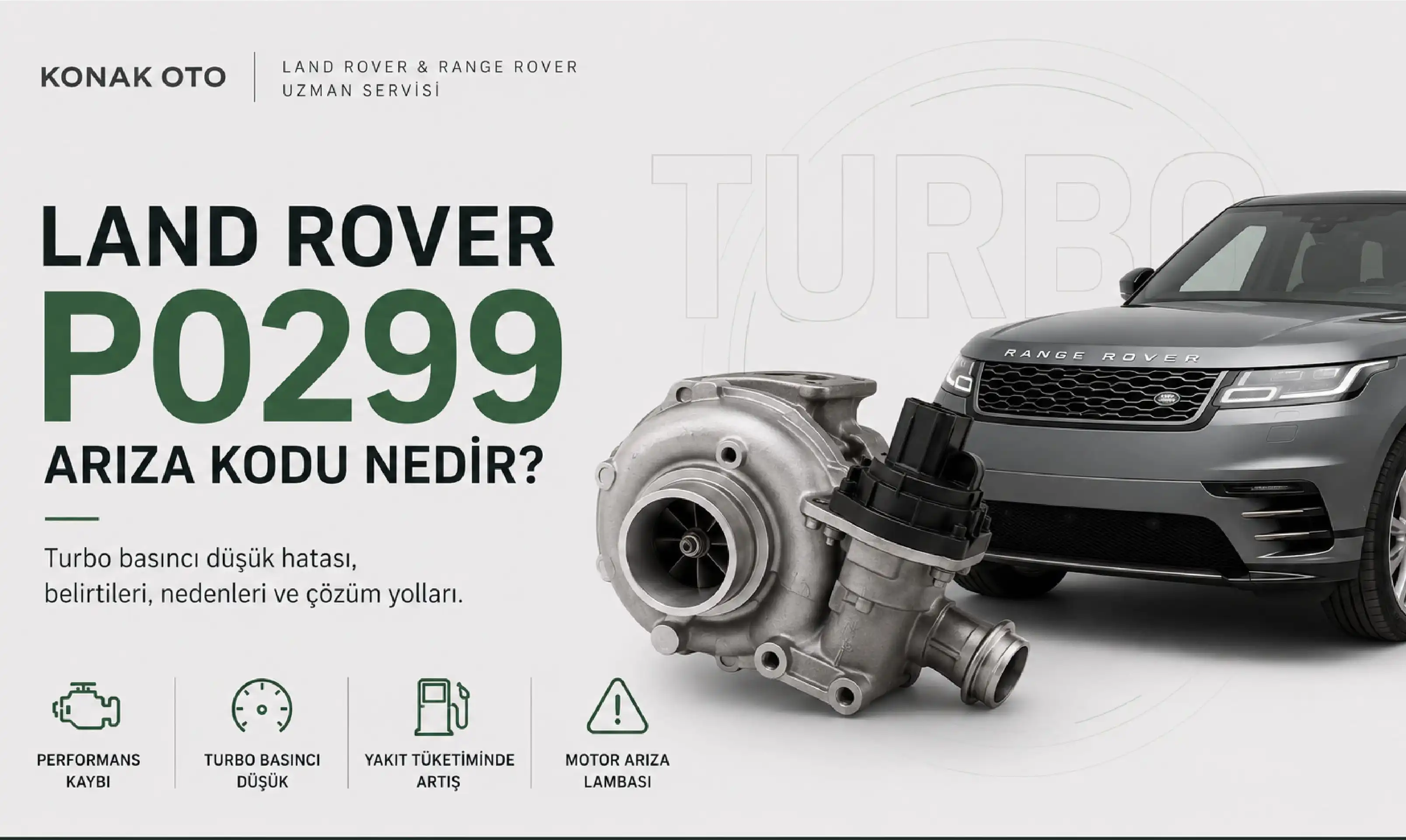
The Land Rover P0299 fault code indicates that the Engine Control Unit (ECU) has detected lower-than-expected turbo boost pressure. Although the issue may involve the turbocharger itself, it can also be caused by boost leaks, intercooler problems, faulty sensors, wastegate issues, or other engine management components. Professional diagnostics are essential to identify the root cause accurately.
Table of Contents
- What Does the P0299 Fault Code Mean?
- How Does the Turbocharger System Work?
- Symptoms of the P0299 Fault Code
- What Causes the P0299 Fault Code?
- How Is the P0299 Fault Diagnosed?
- What Happens If the Fault Is Ignored?
- How Can You Prevent P0299?
- Konak Oto's Turbo Diagnostic Process
- Conclusion
- Frequently Asked Questions
Land Rover P0299 Fault Code: Turbo Underboost Causes, Symptoms & Solutions
The P0299 fault code is one of the most frequently encountered diagnostic trouble codes in turbocharged Land Rover and Range Rover vehicles. It indicates that the Engine Control Unit (ECU) has detected lower-than-expected turbo boost pressure during engine operation.
The turbocharger is designed to increase engine efficiency and performance by forcing additional compressed air into the combustion chambers. The ECU continuously compares the target boost pressure with the actual boost pressure measured by the engine management system.
When the measured boost pressure remains below the expected level for a specific period, the ECU stores the P0299 Diagnostic Trouble Code (DTC) and, in most cases, illuminates the Check Engine Light.
Many drivers immediately assume that the turbocharger itself has failed. In reality, this fault code can also be triggered by boost leaks, damaged intercooler hoses, MAP sensor inaccuracies, wastegate or variable geometry turbo (VGT) issues, vacuum system faults, or other engine management problems.
For this reason, professional diagnostics should always be performed before replacing any turbo-related components.
What Does the P0299 Fault Code Mean?
P0299 is a generic OBD-II Diagnostic Trouble Code (DTC) defined as:
"Turbocharger/Supercharger Underboost Condition."
In simple terms, this means the ECU expected a higher boost pressure than the engine was able to produce.
It is important to understand that P0299 is not a component-specific fault code.
Instead, it identifies a condition where the turbocharging system is unable to achieve its target boost level.
Several different mechanical or electronic issues can produce the same fault code.
Information Box
P0299 Indicates a Condition, Not a Failed Component
A P0299 fault may originate from:
- Turbocharger
- Intercooler
- Charge air hoses
- MAP sensor
- Wastegate actuator
- Variable Geometry Turbo (VGT)
- Vacuum control system
- EGR system
- Electrical wiring
- ECU control strategy
Replacing the turbocharger without identifying the actual cause may result in unnecessary repair costs.
How Does the Turbocharger System Work?
A turbocharger uses energy from exhaust gases to compress incoming air before it enters the engine.
By supplying additional air, the engine can burn fuel more efficiently and produce:
- Higher engine power
- Increased torque
- Improved fuel efficiency
- Lower exhaust emissions under certain operating conditions
Modern Land Rover diesel engines typically include the following turbocharging components:
- Turbocharger
- Wastegate or Variable Geometry Turbo (VGT)
- Intercooler
- Charge air hoses
- MAP Sensor
- Air intake system
- Vacuum control system (where applicable)
- Engine Control Unit (ECU)
A malfunction in any of these components may prevent the engine from reaching its required boost pressure and trigger the P0299 fault code.
Symptoms of the Land Rover P0299 Fault Code
Depending on the severity of the issue, drivers may experience one or more of the following symptoms:
- Illuminated Check Engine Light
- Reduced engine power
- Poor acceleration
- Turbo lag
- Increased fuel consumption
- Black exhaust smoke
- Reduced towing performance
- Limp Mode activation
Some vehicles may only display the Check Engine Light, while others may suffer a noticeable loss of performance.
Reduced Engine Performance
Reduced power is the most common symptom associated with P0299.
Since the ECU detects insufficient boost pressure, it may limit engine output to protect the engine and turbocharger.
Drivers often notice:
- Slow acceleration
- Weak uphill performance
- Reduced overtaking capability
- Delayed throttle response
Limp Mode
Many Land Rover models activate Limp Mode when boost pressure falls below safe operating limits.
In this protective mode:
- Turbo boost is restricted.
- Maximum engine power is reduced.
- Engine RPM may be limited.
- Vehicle performance decreases significantly.
This strategy helps protect critical engine components until the fault has been diagnosed and repaired.
Increased Fuel Consumption
Insufficient boost pressure reduces combustion efficiency.
As a result, the engine may consume more fuel while producing less power, particularly during city driving or under heavy load.
- Faulty vacuum solenoids
- Vacuum pump issues
may prevent the turbocharger from operating correctly.
EGR System Problems
An improperly functioning Exhaust Gas Recirculation (EGR) system may indirectly affect turbocharger efficiency.
Heavy carbon deposits or EGR valve malfunctions may disturb airflow characteristics and contribute to underboost conditions.
Air Filter Restrictions
A severely clogged air filter limits airflow entering the turbocharger.
Reduced airflow decreases compressor efficiency and may eventually trigger a P0299 code.
Routine maintenance helps prevent this issue.
Expert Insight
In many Land Rover vehicles, the turbocharger itself is not the root cause of a P0299 fault.
Professional diagnosis often identifies a simpler issue such as:
- Air leaks
- Sensor inaccuracies
- Vacuum problems
- Control system faults
Replacing the turbocharger before confirming the actual cause may lead to unnecessary repair costs.
How Is the P0299 Fault Diagnosed?
Professional diagnosis goes far beyond reading Diagnostic Trouble Codes.
A complete diagnostic procedure generally includes:
- Reading Diagnostic Trouble Codes (DTCs)
- Reviewing Freeze Frame Data
- Live Data analysis
- Comparing requested boost pressure with actual boost pressure
- MAP sensor verification
- Turbocharger actuator testing
- Charge air leak testing
- Intercooler inspection
- Vacuum system testing
- Electrical wiring inspection
- ECU software verification
Each step helps technicians isolate the true cause of the underboost condition.
Freeze Frame Analysis
Whenever the ECU stores a fault code, it also records operating conditions at the exact moment the fault occurred.
Typical Freeze Frame data includes:
- Engine RPM
- Coolant temperature
- Vehicle speed
- Engine load
- Accelerator pedal position
- Requested boost pressure
- Actual boost pressure
These values help technicians reproduce the conditions that triggered the fault.
Live Data Analysis
One of the most valuable diagnostic tools is Live Data monitoring.
Technicians compare:
- Requested Boost Pressure
- Actual Boost Pressure
- MAP Sensor readings
- MAF Sensor readings
- Turbo actuator position
- Engine load
- Intake air temperature
Large differences between requested and actual boost pressure usually indicate where further inspection is required.
Does P0299 Always Mean the Turbocharger Has Failed?
No.
This is one of the biggest misconceptions among vehicle owners.
Many P0299 cases are ultimately caused by:
- Split intercooler hoses
- Loose boost pipes
- MAP sensor faults
- Vacuum leaks
- Turbo actuator problems
- Carbon build-up
A professional inspection should always be completed before replacing the turbocharger.
What Happens If the P0299 Fault Is Ignored?
Driving with a P0299 fault code for an extended period is not recommended.
Although the vehicle may continue operating, prolonged underboost conditions may lead to:
- Reduced engine performance
- Increased fuel consumption
- Higher exhaust emissions
- Excessive turbocharger workload
- Limp Mode activation
- Additional engine management faults
Addressing the issue early helps reduce repair costs and protects the turbocharging system.
Reduced Performance
As boost pressure decreases, engine output also declines.
Drivers may notice:
- Poor acceleration
- Weak overtaking performance
- Reduced towing capability
- Sluggish throttle response
Increased Fuel Consumption
When the engine cannot generate sufficient boost pressure, combustion efficiency decreases.
To compensate, the engine may consume more fuel while producing less power.
Limp Mode Activation
Many Land Rover models activate Limp Mode to prevent further damage.
In this mode:
- Engine power is limited.
- Turbo boost is restricted.
- Maximum engine speed may be reduced.
The vehicle should be inspected before normal driving resumes.
How Can the P0299 Fault Code Be Prevented?
Although not every turbo-related issue can be prevented, following proper maintenance practices significantly reduces the risk of developing a P0299 Turbo Underboost fault.
Routine inspections and early diagnosis help maintain turbocharger efficiency and overall engine performance.
Follow the Recommended Maintenance Schedule
Regular maintenance is essential for turbocharged Land Rover engines.
Scheduled servicing helps maintain the health of:
- Engine oil
- Air filter
- Intake system
- Turbocharger
- Intercooler
- Boost hoses
Keeping these components in good condition reduces the likelihood of boost-related faults.
Use the Correct Engine Oil
Turbochargers operate at extremely high temperatures and rotational speeds.
Using the manufacturer-approved engine oil and replacing it at the recommended service intervals helps protect the turbocharger bearings and lubrication system.
Poor-quality or overdue engine oil may contribute to premature turbo wear.
Inspect the Boost System Regularly
Small leaks often develop before drivers notice any performance problems.
Routine inspection of:
- Charge air hoses
- Intercooler
- Hose clamps
- Intake connections
can help identify minor issues before they become major repairs.
Do Not Ignore the Check Engine Light
The Check Engine Light is an early warning that the engine management system has detected an abnormal operating condition.
Ignoring the warning may allow a relatively minor problem to develop into a more expensive repair.
Early diagnostics are always the most cost-effective solution.
Information Box
Can a P0299 Fault Clear by Itself?
Sometimes.
Under certain driving conditions, the Check Engine Light may turn off temporarily.
However, if the underlying problem remains unresolved, the ECU is likely to detect the fault again and store another P0299 code.
Simply clearing the code without identifying the root cause does not solve the problem.
Professional P0299 Diagnostics at Konak Oto
Accurate turbocharger diagnosis requires both advanced diagnostic equipment and extensive Land Rover experience.
At Konak Oto, every P0299 fault is investigated through a structured diagnostic procedure that includes:
- Complete electronic system scan
- Live Data analysis
- Requested vs Actual Boost Pressure comparison
- MAP sensor testing
- Turbocharger actuator inspection
- Charge air leak testing
- Intercooler inspection
- Vacuum system evaluation
- ECU software verification
- Adaptation and calibration checks when required
Rather than replacing components based solely on a fault code, our objective is to identify the true source of the problem and recommend the most appropriate repair.
Experience Matters
Since 1996, Konak Oto has specialised exclusively in Land Rover and Range Rover vehicles.
Our technicians understand that identical fault codes can have entirely different causes depending on:
- Vehicle model
- Engine type
- Turbocharger design
- Service history
- Electronic system condition
Every vehicle is diagnosed individually using manufacturer-level procedures and professional diagnostic equipment.
Conclusion
The P0299 Diagnostic Trouble Code indicates that the Engine Control Unit has detected lower-than-expected turbo boost pressure.
However, it is important to remember that P0299 does not automatically mean the turbocharger has failed.
Boost leaks, intercooler damage, MAP sensor inaccuracies, vacuum system faults, turbo actuator problems, EGR-related issues, and other engine management components can all contribute to the same fault code.
Professional diagnostics are essential to identify the true cause before replacing any parts.
Early diagnosis not only protects engine performance but also helps prevent unnecessary repairs and reduces long-term maintenance costs.
Frequently Asked Questions
What does the Land Rover P0299 fault code mean?
The P0299 code indicates that the ECU has detected lower-than-expected turbo boost pressure. It identifies an underboost condition rather than a specific failed component.
Can I continue driving with a P0299 fault?
The vehicle may still operate, but reduced performance or Limp Mode may occur. Driving with the fault for an extended period is not recommended until the underlying issue has been diagnosed.
Does P0299 always mean the turbocharger is faulty?
No.
Many P0299 faults are caused by:
- Boost leaks
- Intercooler problems
- MAP sensor faults
- Vacuum leaks
- Turbo actuator issues
- EGR-related problems
Professional diagnostics are necessary before replacing the turbocharger.
Can a boost hose leak trigger P0299?
Yes.
Leaking boost hoses are among the most common causes of underboost conditions in turbocharged Land Rover vehicles.
Can low boost pressure reduce fuel economy?
Yes.
Insufficient boost pressure decreases combustion efficiency, which may increase fuel consumption while reducing engine performance.
Is P0299 an urgent fault?
Although the vehicle may continue driving, the fault should not be ignored. Early diagnosis helps prevent additional damage and unnecessary repair costs.