
 TR
TR Land Rover P0191 Fault Code: Fuel Rail Pressure Sensor – Causes, Symptoms & Solutions
The Land Rover P0191 fault code indicates that the Engine Control Unit (ECU) has detected an abnormal signal from the Fuel Rail Pressure Sensor. Proper diagnosis requires more than reading fault codes—it requires analysing live data and evaluating the entire Common Rail fuel system.
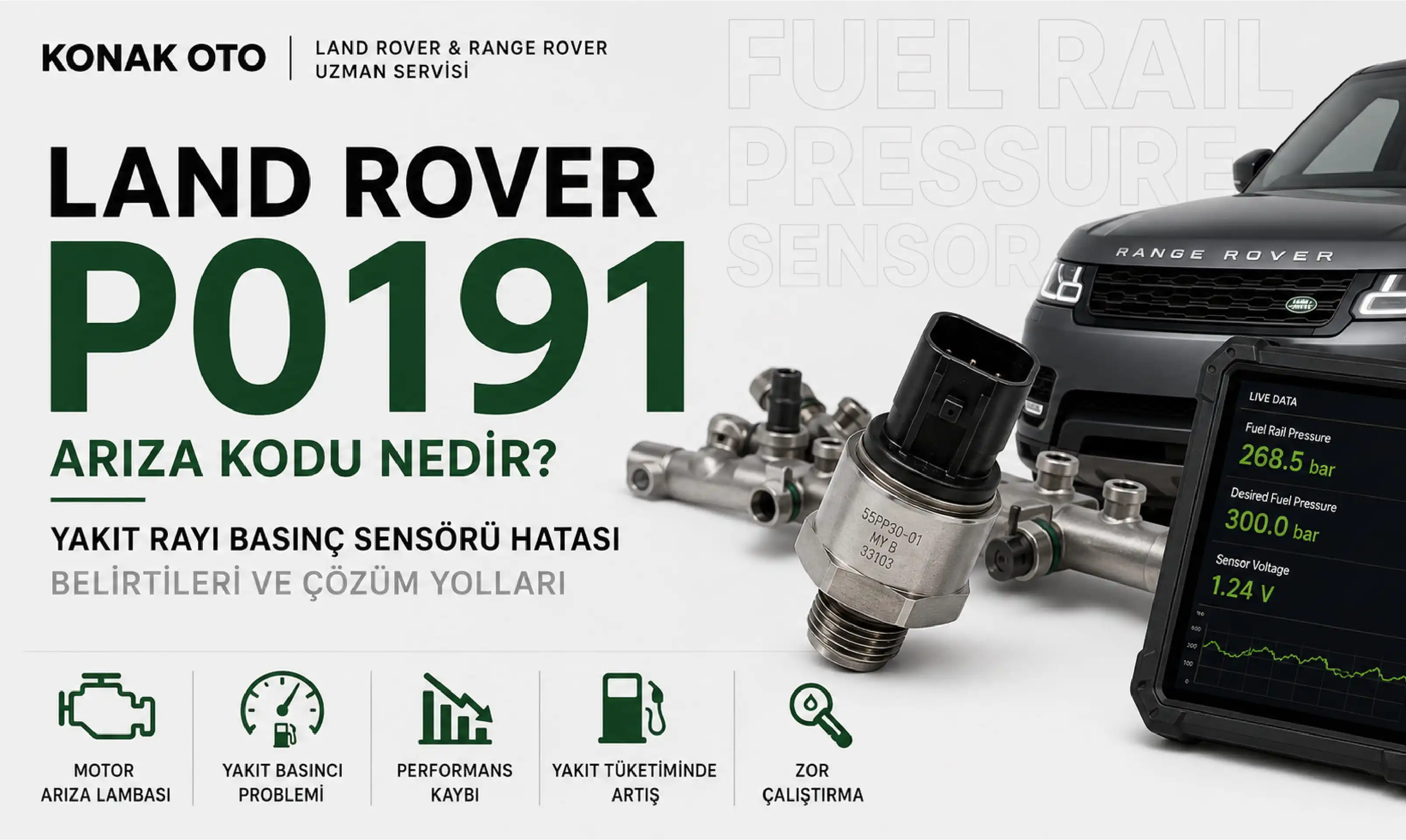
The Land Rover P0191 fault code means that the Engine Control Unit has detected an abnormal or implausible signal from the Fuel Rail Pressure Sensor. The fault may be caused by the sensor itself, wiring problems, unstable fuel pressure, a restricted fuel filter, injector leak-back, or fuel pump issues. Professional diagnostics are required to identify the actual cause.
Table of Contents
- What Is the Land Rover P0191 Fault Code?
- How Does the Fuel Rail Pressure Sensor Work?
- How Does the Common Rail Fuel System Work?
- Symptoms of the Land Rover P0191 Fault
- What Causes the P0191 Fault Code?
- How Is the P0191 Fault Diagnosed?
- What Happens If P0191 Is Ignored?
- How Can the P0191 Fault Be Prevented?
- Fuel System Diagnostics at Konak Oto
- AI Summary
- Conclusion
- Frequently Asked Questions
Land Rover P0191 Fault Code: Fuel Rail Pressure Sensor – Causes, Symptoms & Solutions
The P0191 fault code indicates that the Engine Control Unit has detected a Fuel Rail Pressure Sensor signal that does not match the expected operating conditions of the fuel system. Although the code is commonly associated with the sensor itself, it may also be caused by genuine fuel pressure fluctuations, wiring faults, injector leak-back, a restricted fuel filter, or problems within the high- or low-pressure fuel supply system.
Modern Land Rover and Range Rover diesel engines use a highly precise Common Rail fuel injection system. This system must deliver the correct quantity of fuel to the injectors at a pressure calculated according to engine speed, accelerator demand, engine load, temperature, and driving conditions.
The Fuel Rail Pressure Sensor continuously measures the pressure inside the rail and sends this information to the Engine Control Unit, or ECU. The ECU compares the reported value with the pressure it has requested from the fuel system.
If the sensor signal becomes implausible, unstable, or outside the expected range, the ECU stores the P0191 Diagnostic Trouble Code and normally illuminates the Check Engine Light. Depending on the severity of the condition, the vehicle may also lose power, become difficult to start, run unevenly, or enter Limp Mode.
A common mistake is to replace the Fuel Rail Pressure Sensor immediately after seeing the P0191 code. However, P0191 is not always a direct sensor-failure code. The sensor may be reporting a genuine fuel pressure problem elsewhere in the system.
Possible causes include:
- A faulty Fuel Rail Pressure Sensor
- Damaged wiring or poor connector contact
- A clogged fuel filter
- Weak low-pressure fuel supply
- High-pressure fuel pump performance loss
- Excessive injector leak-back
- Fuel pressure regulator faults
- ECU or calibration issues
For this reason, clearing the code or replacing the sensor without testing the full system may not provide a lasting repair.
This guide explains what the Land Rover P0191 fault code means, how the Fuel Rail Pressure Sensor works, the most common symptoms and causes, and how the fault should be professionally diagnosed.
What Is the Land Rover P0191 Fault Code?
P0191 is a generic OBD-II Diagnostic Trouble Code defined as:
Fuel Rail Pressure Sensor “A” Circuit Range/Performance
In practical terms, the code means that the ECU has identified a Fuel Rail Pressure Sensor signal that is inconsistent with the expected behaviour of the fuel system.
The ECU does not assess the pressure reading in isolation. It compares the signal with several operating parameters, including:
- Requested fuel rail pressure
- Actual fuel rail pressure
- Engine speed
- Accelerator pedal position
- Engine load
- Injection quantity
- Fuel temperature
- Fuel pump control data
If the sensor reports a value that does not logically match these parameters, the ECU may store P0191.
The code can appear when:
- Actual fuel pressure is too low.
- Actual pressure is too high.
- Pressure changes too slowly.
- Pressure fluctuates unexpectedly.
- The electrical signal is intermittent.
- The reported value is implausible compared with engine conditions.
This distinction is important because P0191 does not simply mean “replace the sensor.” It means the ECU has detected an abnormal pressure signal or fuel-system behaviour that requires further investigation.
Information Box
P0191 Is a Result Code
The P0191 fault may be related to:
- Fuel Rail Pressure Sensor
- Sensor connector
- Wiring harness
- Engine Control Unit
- Common Rail fuel system
- High-pressure fuel pump
- Low-pressure fuel pump
- Fuel filter
- Fuel pressure regulator
- Fuel injectors
Replacing the Fuel Rail Pressure Sensor before testing the complete fuel system may create unnecessary expense and leave the original problem unresolved.
How Does the Fuel Rail Pressure Sensor Work?
The Fuel Rail Pressure Sensor (FRPS) is one of the most important components of the Common Rail fuel injection system. Its primary function is to continuously monitor the fuel pressure inside the fuel rail and transmit this information to the Engine Control Unit (ECU) in real time.
Unlike older diesel fuel systems that relied primarily on mechanical control, modern Land Rover and Range Rover engines use electronically controlled fuel injection. This allows the ECU to precisely adjust injection timing and fuel quantity according to driving conditions.
To perform these calculations accurately, the ECU must know the exact fuel pressure available in the rail at every moment.
The Fuel Rail Pressure Sensor measures this pressure many times per second and converts it into an electrical voltage signal. The ECU then interprets this signal and compares it with the target pressure calculated for the current operating conditions.
If the reported pressure differs significantly from the expected value, the ECU immediately adjusts fuel delivery. When the difference becomes excessive or the sensor signal becomes implausible, the ECU stores the P0191 Diagnostic Trouble Code.
How Does the Common Rail Fuel System Work?
Modern Land Rover diesel engines use a Common Rail direct injection system, which separates fuel pressure generation from fuel injection.
The system operates through the following sequence:
- Fuel is drawn from the fuel tank by the low-pressure fuel pump.
- The fuel passes through the fuel filter, where contaminants are removed.
- The high-pressure fuel pump compresses the fuel to extremely high pressure.
- Pressurised fuel is stored inside the Common Rail (fuel rail).
- Electronically controlled injectors deliver the precise amount of fuel into each cylinder.
- Throughout this entire process, the Fuel Rail Pressure Sensor continuously reports fuel pressure to the ECU.
Because injection timing and fuel pressure are electronically controlled, even a small deviation in pressure can affect combustion efficiency, engine performance, emissions, and fuel economy.
Why Is the Fuel Rail Pressure Sensor So Important?
The Fuel Rail Pressure Sensor is one of the ECU's primary references for managing the fuel system.
Accurate pressure readings allow the ECU to:
- Maintain correct injection pressure
- Optimise engine performance
- Improve fuel efficiency
- Reduce exhaust emissions
- Protect injectors and the fuel pump
- Ensure smooth engine operation
If the ECU receives incorrect pressure information, it may command inappropriate fuel delivery.
This can result in:
- Poor acceleration
- Rough engine operation
- Increased fuel consumption
- Hard starting
- Limp Mode activation
- Check Engine Light illumination
Information Box
Where Is the Fuel Rail Pressure Sensor Located?
On most Land Rover diesel engines, the Fuel Rail Pressure Sensor is mounted directly on the Common Rail fuel rail.
Its primary responsibilities include:
- Measuring fuel pressure
- Sending voltage signals to the ECU
- Helping regulate injection pressure
- Monitoring fuel system performance
The exact location may vary depending on the engine generation and model.
Symptoms of the Land Rover P0191 Fault
The symptoms associated with the P0191 fault code can vary depending on the severity of the fuel system problem.
Some vehicles may display only the Check Engine Light, while others may experience noticeable drivability issues.
Common symptoms include:
- Check Engine Light
- Reduced engine performance
- Delayed throttle response
- Poor acceleration
- Rough idle
- Difficult starting
- Engine stalling
- Increased fuel consumption
- Limp Mode activation
- Hesitation under acceleration
Not every symptom appears on every vehicle. The severity depends on the underlying cause affecting the Common Rail fuel system.
Check Engine Light
The most common symptom is the illumination of the Check Engine Light.
When the ECU detects inconsistent or implausible fuel pressure readings, it stores the P0191 Diagnostic Trouble Code and alerts the driver.
In some cases, the warning appears continuously, while in others it may occur only under specific driving conditions.
Reduced Engine Performance
If the ECU cannot accurately control fuel pressure, it may intentionally limit engine output to protect the fuel system.
Drivers may notice:
- Reduced acceleration
- Poor hill-climbing performance
- Limited engine power
- Sluggish response during overtaking
Performance loss is often more noticeable under heavy engine load.
Slow Throttle Response
Incorrect fuel pressure prevents the engine from receiving the amount of fuel requested by the ECU.
As a result, the vehicle may respond slowly when the accelerator pedal is pressed.
Drivers often describe this symptom as:
- Poor throttle response
- Delayed acceleration
- The engine feeling "lazy"
- Hesitation before gaining speed
Rough Idle
Unstable fuel pressure can affect injection consistency, leading to rough engine operation while idling.
Typical symptoms include:
- Idle speed fluctuations
- Engine vibration
- Uneven engine sound
- Occasional misfire sensation
Engine Stalling
In more severe cases, unstable fuel pressure may prevent the engine from maintaining proper combustion.
The vehicle may:
- Stall shortly after starting
- Stall while idling
- Stall during low-speed driving
Although less common, this symptom requires immediate diagnosis because it may indicate a significant fuel delivery problem.
Can You Drive with a Land Rover P0191 Fault Code?
The vehicle may remain drivable for a short period, but continued operation with unstable fuel pressure can lead to poor performance, increased fuel consumption, Limp Mode activation, and possible damage to fuel system components. Professional diagnostics are recommended as soon as the P0191 fault code appears.
What Causes the Land Rover P0191 Fault Code?
The P0191 fault code does not automatically indicate a failed Fuel Rail Pressure Sensor. Instead, it tells us that the ECU has detected fuel pressure information that falls outside the expected operating range or behaves in an implausible manner.
The underlying problem may be electrical, hydraulic, or mechanical.
Professional diagnostics should always evaluate the entire Common Rail fuel system, rather than focusing on a single component.
Faulty Fuel Rail Pressure Sensor
One of the most common causes of P0191 is a defective Fuel Rail Pressure Sensor.
Over time, the sensor may become less accurate due to:
- Internal electronic failure
- Heat-related deterioration
- Fuel contamination
- Moisture intrusion
- Age-related wear
When the sensor reports incorrect pressure values, the ECU may receive inaccurate information and adjust fuel delivery incorrectly.
This can result in:
- Check Engine Light illumination
- Poor engine performance
- Increased fuel consumption
- Rough idle
- P0191 fault code storage
Although sensor failure is common, it should never be assumed without proper testing.
Wiring Harness or Connector Problems
The Fuel Rail Pressure Sensor communicates with the ECU through an electrical wiring harness.
Problems such as:
- Corroded terminals
- Loose electrical connectors
- Damaged insulation
- Broken wires
- Short circuits
- High circuit resistance
can distort the voltage signal sent by the sensor.
In many cases, the sensor itself is fully functional, while the real issue lies within the electrical circuit.
Inspecting the wiring harness is therefore an essential part of professional diagnostics.
High-Pressure Fuel Pump Problems
The high-pressure fuel pump is responsible for generating the fuel pressure required by the Common Rail system.
If the pump cannot maintain the requested pressure due to wear or internal damage, the ECU may detect a mismatch between desired and actual rail pressure.
Common symptoms include:
- Poor acceleration
- Hard starting
- Reduced engine power
- Pressure fluctuations
- P0191 fault code
High-pressure pump issues may also trigger related fault codes such as P0087.
Low-Pressure Fuel Supply Problems
Before fuel reaches the high-pressure pump, it must be delivered by the low-pressure fuel supply system.
Problems within this stage may include:
- Weak lift pump performance
- Restricted fuel lines
- Air entering the fuel system
- Fuel supply leaks
- Blocked fuel pickup
Any reduction in fuel supply can prevent the high-pressure pump from maintaining stable rail pressure.
The ECU may interpret these pressure fluctuations as a Fuel Rail Pressure Sensor performance problem.
Restricted Fuel Filter
A clogged fuel filter is another common cause of unstable fuel pressure.
As contaminants accumulate inside the filter, fuel flow becomes restricted.
This may lead to:
- Reduced fuel supply
- Lower rail pressure
- Increased pump workload
- Pressure instability
- P0191 fault code
Replacing the fuel filter at the manufacturer's recommended service intervals helps prevent unnecessary fuel system problems.
Injector Leak-Back
Fuel injectors are designed to return a small amount of fuel to the tank for cooling and lubrication.
However, excessive internal injector leakage—commonly known as injector leak-back—can significantly reduce rail pressure.
If one or more injectors return too much fuel:
- Rail pressure drops unexpectedly.
- The ECU struggles to maintain target pressure.
- Engine performance decreases.
- P0191 or P0087 may be stored.
Professional technicians typically perform an Injector Leak-Off Test to confirm this condition.
Fuel Pressure Regulator Problems
The fuel pressure regulator helps maintain stable pressure throughout the Common Rail system.
If the regulator sticks, leaks, or responds incorrectly, pressure may fluctuate beyond acceptable limits.
This can cause:
- Pressure instability
- Rough engine operation
- Difficult starting
- Performance loss
- P0191 fault code
Poor Fuel Quality
Fuel quality has a direct impact on the durability of modern Common Rail systems.
Contaminated or poor-quality diesel fuel may contribute to:
- Fuel filter blockage
- Injector contamination
- Pump wear
- Sensor contamination
- Pressure irregularities
Using high-quality fuel from reputable suppliers helps protect the entire injection system.
ECU Software or Calibration Issues
Although relatively uncommon, outdated ECU software or incorrect calibration may occasionally contribute to P0191.
Some Land Rover models may require ECU software updates or recalibration following certain repairs.
Professional diagnostics should always verify that the ECU software version is current before replacing expensive components.
Expert Insight
Replacing the Fuel Rail Pressure Sensor should never be the first step when diagnosing a Land Rover P0191 fault code.
At Konak Oto, professional diagnostics include analysing:
- Live Rail Pressure
- Desired vs Actual Fuel Pressure
- Fuel Rail Pressure Sensor voltage
- Wiring integrity
- Fuel filter condition
- Low-pressure fuel supply
- High-pressure fuel pump performance
- Injector leak-back values
- ECU live data
Only after evaluating the complete fuel system can the actual cause be identified with confidence.
This systematic approach helps eliminate unnecessary parts replacement while ensuring an accurate and cost-effective repair.
What Is the Most Common Cause of the Land Rover P0191 Fault Code?
The most common causes of the Land Rover P0191 fault code include a faulty Fuel Rail Pressure Sensor, damaged wiring, high-pressure fuel pump wear, a restricted fuel filter, injector leak-back, and unstable fuel pressure within the Common Rail system. Accurate diagnosis requires professional testing of the complete fuel system rather than replacing the sensor based solely on the stored fault code.
How Is the Land Rover P0191 Fault Diagnosed?
Accurately diagnosing the Land Rover P0191 fault code requires much more than simply reading the stored Diagnostic Trouble Code with an OBD-II scanner.
Because P0191 is a performance-related fault code, technicians must determine why the ECU considers the Fuel Rail Pressure Sensor signal abnormal. This involves analysing the complete fuel system rather than focusing on a single component.
A professional diagnostic procedure generally includes:
- Reading all stored Diagnostic Trouble Codes (DTCs)
- Reviewing Freeze Frame data
- Monitoring live fuel rail pressure
- Comparing actual and requested rail pressure
- Testing Fuel Rail Pressure Sensor voltage
- Inspecting electrical wiring and connectors
- Checking the fuel filter
- Evaluating the low-pressure fuel supply
- Testing the high-pressure fuel pump
- Performing an injector leak-back test
- Analysing ECU live data
Following this structured process allows technicians to identify the root cause before replacing expensive components.
Why Is Freeze Frame Data Important?
Whenever the ECU stores the P0191 fault code, it also records a snapshot of the vehicle's operating conditions.
Freeze Frame data typically includes:
- Engine RPM
- Vehicle speed
- Accelerator pedal position
- Fuel rail pressure
- Requested fuel pressure
- Engine load
- Coolant temperature
- Fuel temperature
These values help technicians determine the exact conditions under which the fault occurred.
For example, the issue may only appear:
- during cold starts,
- under heavy acceleration,
- while climbing hills,
- during motorway driving,
- or only at idle.
Understanding when the fault occurs significantly improves diagnostic accuracy.
Live Data Analysis
Live Data analysis is one of the most valuable diagnostic tools for investigating the P0191 fault.
Using manufacturer-level diagnostic equipment, technicians monitor several parameters simultaneously, including:
- Actual Fuel Rail Pressure
- Desired Fuel Rail Pressure
- Fuel Rail Pressure Sensor Voltage
- Fuel Pump Duty Cycle
- Fuel Temperature
- Injector Correction Values
- Engine Load
- Engine Speed
By comparing actual pressure with the ECU's requested pressure, technicians can determine whether the problem is caused by the sensor, fuel delivery, injectors, or pump performance.
Unlike reading stored fault codes, Live Data analysis shows what the fuel system is doing in real time.
Information Box
Does P0191 Always Require a New Fuel Rail Pressure Sensor?
No.
Many Land Rover vehicles displaying the P0191 fault code are ultimately diagnosed with problems unrelated to the Fuel Rail Pressure Sensor itself.
Possible causes include:
- A restricted fuel filter
- High-pressure fuel pump wear
- Low-pressure fuel supply issues
- Excessive injector leak-back
- Wiring faults
- ECU-related problems
Replacing the sensor without a complete diagnostic inspection may leave the original fault unresolved.
What Happens If the P0191 Fault Is Ignored?
Fuel pressure plays a critical role in combustion efficiency and engine reliability.
Ignoring the P0191 fault for an extended period may allow a relatively minor issue to develop into a much more expensive repair.
Possible consequences include:
- Reduced engine performance
- Increased fuel consumption
- Limp Mode activation
- Poor throttle response
- Engine stalling
- Injector damage
- High-pressure fuel pump wear
- Starting difficulties
Early diagnosis helps protect both engine performance and the fuel injection system.
Limp Mode Activation
If the ECU detects unstable fuel pressure that could potentially damage the engine or fuel system, it may activate Limp Mode.
When this occurs, drivers may experience:
- Limited engine power
- Restricted engine speed
- Poor acceleration
- Reduced turbo performance
Limp Mode is designed to protect the engine until the fault has been repaired.
Fuel System Damage
Operating with unstable fuel pressure for extended periods may place additional stress on critical fuel system components.
This may eventually affect:
- High-pressure fuel pump
- Fuel injectors
- Fuel rail
- Pressure regulator
Addressing the fault early can help avoid significantly higher repair costs.
How Can the P0191 Fault Be Prevented?
Although not every failure can be prevented, proper maintenance greatly reduces the likelihood of fuel pressure-related faults.
Recommended preventive measures include:
- Replace the fuel filter at the recommended service intervals.
- Use high-quality diesel fuel.
- Perform regular diagnostic inspections.
- Do not ignore the Check Engine Light.
- Inspect sensor wiring during routine servicing.
- Use OEM or manufacturer-approved replacement parts.
- Follow the manufacturer's maintenance schedule.
Routine maintenance is often the most effective way to extend the life of the Common Rail fuel system.
Professional Fuel System Diagnostics at Konak Oto
At Konak Oto, diagnosing a P0191 fault involves far more than simply reading the stored fault code.
Our technicians perform a comprehensive evaluation using manufacturer-level diagnostic equipment.
The diagnostic procedure includes:
- Complete system scan
- Live fuel rail pressure analysis
- Fuel Rail Pressure Sensor testing
- Desired vs Actual Pressure comparison
- Fuel filter inspection
- Low-pressure fuel supply testing
- High-pressure fuel pump evaluation
- Injector leak-back testing
- Wiring inspection
- ECU live data analysis
This systematic approach allows us to identify the true cause of the fault before recommending any repairs.
Experience Matters
Since 1996, Konak Oto has specialised exclusively in Land Rover and Range Rover vehicles.
Our technicians have extensive experience diagnosing Common Rail fuel system faults across multiple generations of Land Rover diesel engines.
Because no two vehicles fail in exactly the same way, every diagnosis is based on real-time diagnostic data, technical expertise, and manufacturer-approved testing procedures rather than assumptions.
The Land Rover P0191 fault code indicates that the Engine Control Unit has detected an abnormal signal from the Fuel Rail Pressure Sensor or inconsistent fuel pressure within the Common Rail system. Although a faulty sensor is a common cause, wiring faults, injector leak-back, clogged fuel filters, high-pressure fuel pump wear, and unstable fuel delivery may also trigger the code. Professional diagnostics using Live Data and complete fuel system analysis are essential to identify the actual fault and prevent unnecessary parts replacement.
Conclusion
The Land Rover P0191 Diagnostic Trouble Code is an important indication that the Common Rail fuel system is not operating as expected.
Although many drivers immediately suspect the Fuel Rail Pressure Sensor, the underlying cause may involve several different components throughout the fuel system.
Accurate diagnosis requires far more than reading the stored fault code. Live Data analysis, fuel pressure testing, injector evaluation, and electrical inspections are all essential for identifying the true source of the problem.
Early diagnosis not only restores engine performance but also helps prevent costly damage to injectors, fuel pumps, and other critical components.
Frequently Asked Questions
Can I continue driving with the P0191 fault code?
The vehicle may remain drivable for a short period, but unstable fuel pressure can reduce performance, activate Limp Mode, and potentially damage fuel system components. Professional diagnosis is recommended as soon as possible.
Does P0191 always mean the Fuel Rail Pressure Sensor is faulty?
No. Wiring issues, injector leak-back, restricted fuel filters, fuel pump problems, and ECU-related faults can all trigger the same diagnostic code.
Can a clogged fuel filter cause the P0191 fault?
Yes. Restricted fuel flow may prevent the Common Rail system from maintaining stable fuel pressure, causing the ECU to store the P0191 fault code.
Does P0191 affect engine performance?
Yes. Reduced power, hesitation, poor acceleration, rough idle, and increased fuel consumption are common symptoms.
Can the P0191 fault return after repairs?
Yes. If only the fault code is cleared without correcting the underlying cause, the ECU will detect the abnormal fuel pressure again and store the P0191 code.