
 TR
TR Land Rover P0116 Fault Code: Engine Coolant Temperature Sensor Causes, Symptoms & Solutions
The Land Rover P0116 fault code indicates that the Engine Control Unit (ECU) has detected abnormal readings from the Engine Coolant Temperature (ECT) sensor. This guide explains the causes, symptoms, diagnostic procedures, and repair solutions for P0116 faults.
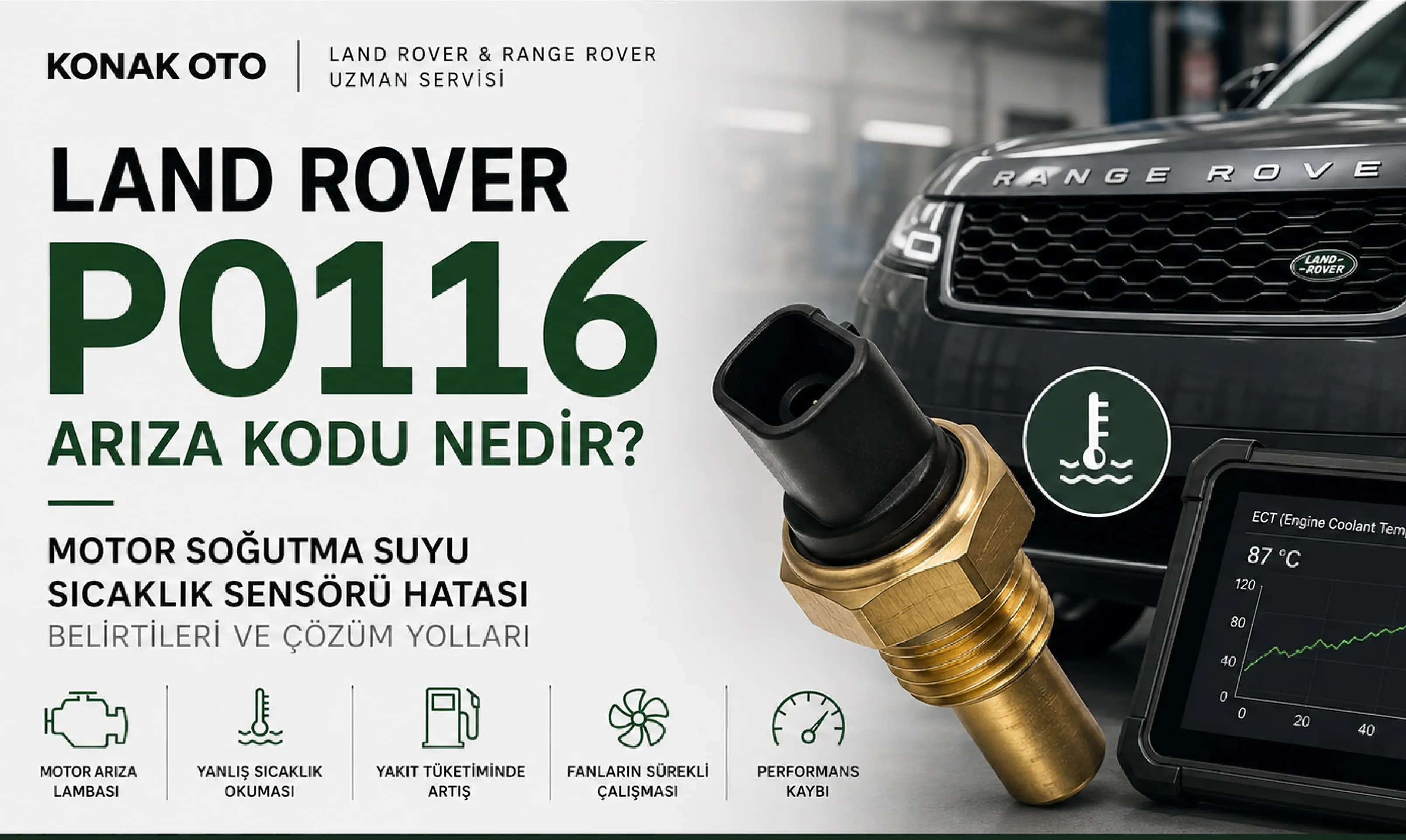
The Land Rover P0116 fault code indicates that the Engine Control Unit (ECU) has detected an abnormal operating range or performance issue with the Engine Coolant Temperature (ECT) sensor. Although the sensor itself may be faulty, problems with the thermostat, cooling system, wiring, or ECU can also trigger this code. Accurate diagnosis requires analysing live coolant temperature data alongside the vehicle's cooling system.
Table of Contents
- What Does the P0116 Fault Code Mean?
- What Is the Engine Coolant Temperature (ECT) Sensor?
- Symptoms of the P0116 Fault Code
- What Causes the P0116 Fault Code?
- How Is the P0116 Fault Diagnosed?
- What Happens If the Fault Is Ignored?
- How Can You Prevent P0116?
- Konak Oto's Diagnostic Process
- Conclusion
- Frequently Asked Questions
Land Rover P0116 Fault Code: Engine Coolant Temperature Sensor Causes, Symptoms & Solutions
The P0116 fault code is one of the most common cooling system-related Diagnostic Trouble Codes (DTCs) found in Land Rover and Range Rover vehicles. It indicates that the Engine Control Unit (ECU) has detected an abnormal operating range or performance issue with the Engine Coolant Temperature (ECT) sensor.
The ECT sensor continuously measures the temperature of the engine coolant and transmits this information to the ECU. The engine management system uses these readings to control:
- Fuel injection
- Ignition timing
- Cooling fan operation
- Idle speed
- Emissions control
- Engine warm-up strategy
If the ECU determines that the coolant temperature signal is inconsistent with the engine's actual operating conditions, it stores the P0116 Diagnostic Trouble Code and usually illuminates the Check Engine Light.
Many vehicle owners immediately assume that the ECT sensor has failed. However, this fault code may also be caused by thermostat issues, low coolant levels, wiring problems, poor electrical connections, or, in rare cases, ECU-related faults.
For this reason, professional diagnostics should always be performed before replacing any components.
What Does the P0116 Fault Code Mean?
P0116 is a generic OBD-II Diagnostic Trouble Code defined as:
"Engine Coolant Temperature Sensor 1 Circuit Range/Performance."
In simple terms, the ECU has detected that the coolant temperature signal is outside its expected operating range.
It is important to understand that P0116 does not automatically mean the ECT sensor has failed.
Instead, it indicates that the ECU has identified an abnormal temperature signal that requires further investigation.
Information Box
P0116 Is a Result Code
The P0116 fault may be caused by:
- Engine Coolant Temperature (ECT) sensor
- Thermostat
- Low coolant level
- Cooling system faults
- Wiring harness damage
- Electrical connector corrosion
- ECU software or control issues
Replacing the sensor without proper diagnosis may not solve the problem.
What Is the Engine Coolant Temperature (ECT) Sensor?
The Engine Coolant Temperature (ECT) sensor continuously monitors coolant temperature and provides this information to the ECU.
Based on these readings, the ECU controls:
- Fuel delivery
- Ignition timing
- Cooling fan activation
- Idle speed
- Cold-start enrichment
- Emission control strategies
Incorrect temperature readings may affect multiple engine management functions and overall vehicle performance.
Symptoms of the Land Rover P0116 Fault Code
Common symptoms include:
- Illuminated Check Engine Light
- Increased fuel consumption
- Rough idle
- Delayed engine warm-up
- Cooling fans running continuously
- Hard starting
- Reduced engine performance
- Abnormal temperature gauge readings
The severity of symptoms varies depending on the underlying cause.
Increased Fuel Consumption
If the ECU believes the engine is colder than it actually is, it may command a richer air-fuel mixture.
This can result in:
- Higher fuel consumption
- Increased exhaust emissions
- Reduced fuel efficiency
Cooling Fans Running Continuously
In some cases, incorrect ECT readings may cause the ECU to activate the cooling fans as a protective measure, even when the engine is operating at normal temperature.
Hard Starting
Incorrect coolant temperature information may affect cold-start fuel calculations, making the engine more difficult to start, particularly in colder weather.
What Causes the P0116 Fault Code?
Several different conditions may trigger the P0116 fault.
Common causes include:
Faulty ECT Sensor
Over time, the Engine Coolant Temperature sensor may become inaccurate or fail electrically.
Thermostat Failure
If the thermostat remains stuck open or closed, coolant temperature may not match the values expected by the ECU.
Low Coolant Level
Insufficient coolant may prevent accurate temperature measurement and affect overall cooling system performance.
Wiring Problems
Electrical faults such as:
- Broken wires
- Short circuits
- Corroded connectors
- Loose terminals
may interrupt or distort the ECT sensor signal.
ECU or Software Issues
Although uncommon, software faults or ECU-related problems may also trigger the P0116 fault code.
Expert Insight
In many Land Rover vehicles, P0116 is not caused by the ECT sensor itself.
Professional diagnosis should include evaluation of the thermostat, coolant level, wiring integrity, and Live Data before replacing any components.
How Is the P0116 Fault Diagnosed?
Professional diagnosis involves much more than simply reading fault codes.
A complete diagnostic procedure generally includes:
- Reading Diagnostic Trouble Codes (DTCs)
- Freeze Frame analysis
- Live Data monitoring
- Engine operating temperature verification
- Thermostat performance testing
- Coolant level inspection
- ECT sensor resistance and voltage testing
- Wiring and connector inspection
- ECU software verification
Only by analysing all these systems together can technicians accurately identify the root cause.
Freeze Frame Analysis
When the fault occurs, the ECU records operating conditions such as:
- Engine RPM
- Coolant temperature
- Vehicle speed
- Engine load
- Intake air temperature
- Fuel trim values
These values help technicians understand the circumstances under which the fault occurred.
Live Data Analysis
Professional diagnostics compare:
- ECT sensor readings
- Intake air temperature
- Actual engine operating temperature
- Thermostat behaviour
- Cooling fan activation
- Fuel correction values
Significant differences between expected and actual temperatures often reveal the underlying issue.
Information Box
Does P0116 Always Require ECT Sensor Replacement?
No.
Many P0116 faults are caused by:
- Thermostat failures
- Low coolant
- Wiring faults
- Connector corrosion
- ECU software issues
Professional diagnosis should always be completed before replacing the ECT sensor.
What Happens If the P0116 Fault Is Ignored?
Ignoring inaccurate coolant temperature readings may eventually lead to:
- Increased fuel consumption
- Reduced engine performance
- Higher emissions
- Difficult starting
- Incorrect cooling fan operation
- Additional fault codes
Early diagnosis helps prevent unnecessary repairs and protects engine performance.
How Can the P0116 Fault Be Prevented?
The likelihood of developing P0116 can be reduced by:
- Checking coolant level regularly
- Following scheduled maintenance intervals
- Inspecting the cooling system
- Using manufacturer-approved coolant
- Addressing Check Engine Lights promptly
Routine maintenance helps ensure accurate temperature monitoring and reliable engine operation.
Professional P0116 Diagnostics at Konak Oto
At Konak Oto, diagnosing the P0116 fault involves a comprehensive evaluation of the cooling system rather than replacing components based solely on the fault code.
Our technicians perform:
- Complete electronic diagnostics
- Live coolant temperature analysis
- ECT sensor testing
- Thermostat evaluation
- Cooling system pressure testing
- Wiring inspection
- ECU software verification
- Adaptation procedures when required
This structured diagnostic approach helps identify the actual cause while avoiding unnecessary component replacement.
Experience Matters
Since 1996, Konak Oto has specialised exclusively in Land Rover and Range Rover vehicles.
Every P0116 fault is evaluated according to the specific engine, model, and diagnostic data to ensure accurate diagnosis and effective repair planning.
Conclusion
The Land Rover P0116 Diagnostic Trouble Code indicates that the ECU has detected abnormal performance or operating range from the Engine Coolant Temperature sensor.
However, the fault is not always caused by the sensor itself. Thermostat problems, coolant loss, wiring faults, or ECU-related issues may produce the same code.
Professional diagnostics that include Live Data analysis and cooling system inspection are essential for identifying the true cause and preventing unnecessary repairs.
Frequently Asked Questions
Can I drive with a P0116 fault code?
The vehicle may continue operating, but prolonged driving with incorrect coolant temperature readings may reduce efficiency and increase the risk of additional problems. A diagnostic inspection is recommended.
Does P0116 always mean the ECT sensor is faulty?
No. The fault may also be caused by thermostat problems, low coolant level, wiring faults, electrical connector issues, or ECU-related conditions.
Can a faulty ECT sensor increase fuel consumption?
Yes. Incorrect coolant temperature readings may cause the ECU to inject more fuel than necessary, reducing fuel economy.
Can P0116 cause engine overheating?
Not directly. However, if the underlying cause is related to the cooling system or thermostat, overheating may occur.