
 TR
TR Land Rover P0087 Fault Code: Fuel Rail Pressure Too Low – Causes, Symptoms & Solutions
The Land Rover P0087 fault code indicates that the fuel rail pressure has dropped below the level required by the Engine Control Unit (ECU). This guide explains the causes, symptoms, diagnostic procedures, and professional repair solutions for P0087 faults.
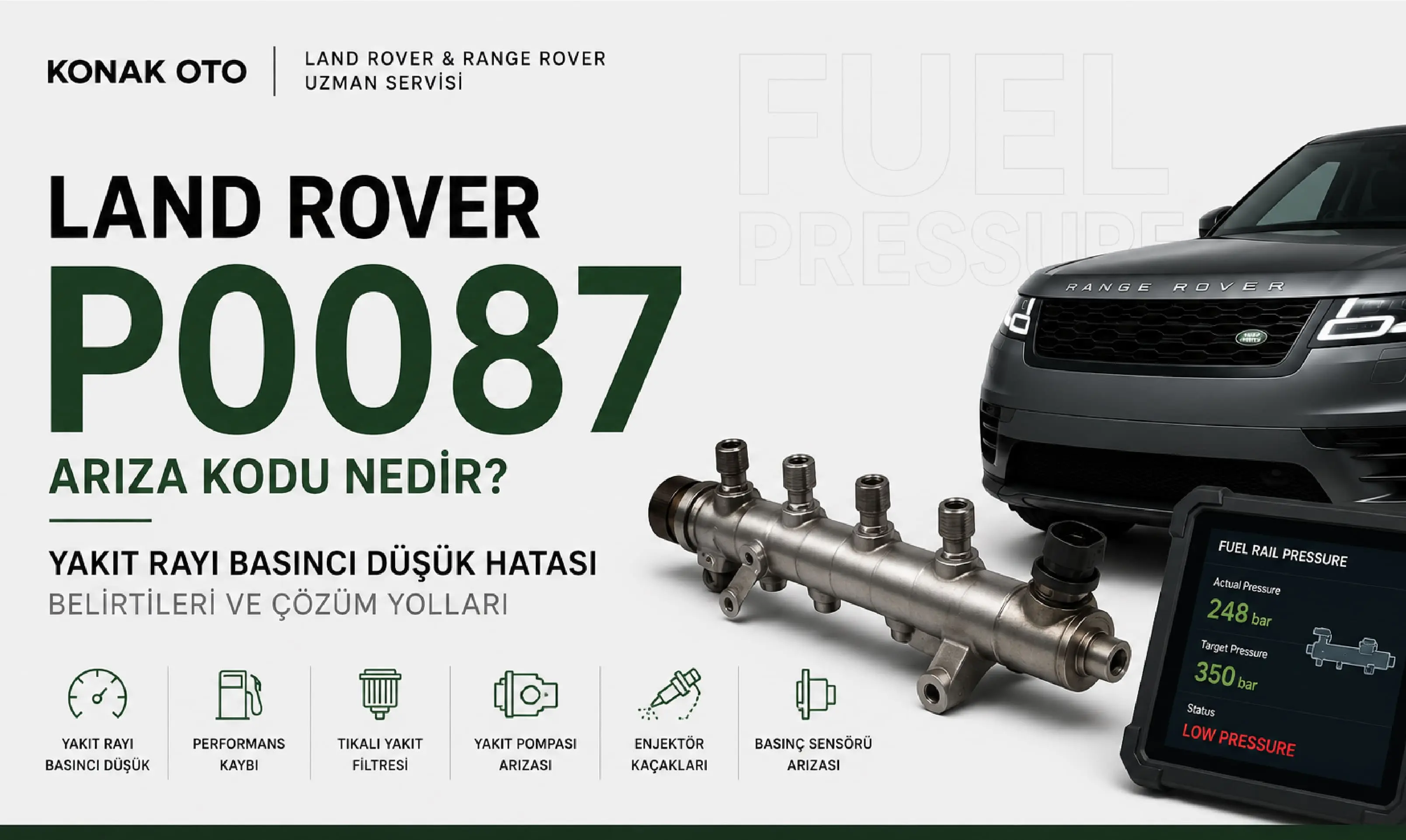
The Land Rover P0087 fault code indicates that the Engine Control Unit (ECU) has detected fuel rail pressure below the required operating level. Although a faulty high-pressure fuel pump is a common cause, clogged fuel filters, leaking injectors, fuel pressure sensor failures, or low-pressure fuel supply problems may also trigger this fault. Professional diagnosis is essential for an accurate repair.
Table of Contents
- What Does the P0087 Fault Code Mean?
- What Is the Common Rail Fuel System?
- Symptoms of the P0087 Fault Code
- What Causes the P0087 Fault Code?
- How Is the P0087 Fault Diagnosed?
- What Happens If the Fault Is Ignored?
- How Can You Prevent P0087?
- Professional Diagnostics at Konak Oto
- Conclusion
- Frequently Asked Questions
Land Rover P0087 Fault Code: Fuel Rail Pressure Too Low – Causes, Symptoms & Solutions
The Common Rail Fuel Injection System used in modern Land Rover and Range Rover diesel engines plays a critical role in engine performance, fuel efficiency, and emissions.
To ensure efficient combustion, the Engine Control Unit (ECU) continuously monitors the pressure inside the fuel rail. If the ECU detects that fuel pressure has dropped below the required operating level, it stores the P0087 Diagnostic Trouble Code (DTC) and typically illuminates the Check Engine Light.
However, contrary to what many drivers believe, the P0087 fault code does not automatically mean that the high-pressure fuel pump has failed.
This fault may be caused by:
- A faulty high-pressure fuel pump
- A clogged fuel filter
- A defective fuel rail pressure sensor
- Leaking fuel injectors
- Low-pressure fuel supply problems
- Fuel line leaks
- Electrical wiring faults
- ECU-related issues
Simply clearing the fault code or replacing a single component rarely provides a permanent solution.
In this guide, we explain what the Land Rover P0087 fault code means, its symptoms, possible causes, professional diagnostic procedures, and repair solutions.
What Does the P0087 Fault Code Mean?
P0087 is a generic OBD-II Diagnostic Trouble Code defined as:
"Fuel Rail/System Pressure Too Low."
In simple terms, the Engine Control Unit has detected that fuel pressure within the Common Rail system has dropped below the level required for safe and efficient engine operation.
The ECU continuously monitors:
- Fuel rail pressure
- Fuel pump performance
- Fuel pressure sensor readings
- Engine RPM
- Accelerator pedal position
- Fuel injection quantity
- Engine load
When fuel pressure falls below the target value, the ECU stores the P0087 fault code and may limit engine performance to protect critical fuel system components.
It is important to understand that P0087 does not always indicate a failed high-pressure fuel pump.
Information Box
P0087 Is a Result Code
The P0087 fault may be caused by:
- High-pressure fuel pump
- Fuel filter
- Fuel rail pressure sensor
- Fuel injectors
- Low-pressure fuel pump
- Fuel line leaks
- Fuel pressure regulator
- Electrical wiring
- ECU
Replacing the fuel pump without diagnosing the complete system may not solve the problem.
What Is the Common Rail Fuel System?
The Common Rail system is the electronically controlled high-pressure fuel injection system used in modern Land Rover diesel engines.
The process works as follows:
- Fuel is drawn from the tank by the low-pressure pump.
- It is delivered to the high-pressure fuel pump.
- The fuel is compressed and stored inside the fuel rail.
- The ECU precisely controls fuel delivery through the injectors.
This system provides:
- Improved engine performance
- Lower fuel consumption
- Reduced emissions
- Quieter engine operation
Even small pressure deviations can significantly affect engine performance.
What Does the Fuel Rail Do?
The fuel rail acts as a high-pressure reservoir that distributes fuel evenly to each injector.
The ECU constantly monitors rail pressure.
If actual pressure falls below the calculated target, the ECU may trigger the P0087 fault code.
Symptoms of the Land Rover P0087 Fault Code
Common symptoms include:
- Check Engine Light
- Reduced engine performance
- Poor acceleration
- Lack of power
- Hard starting
- Engine stalling
- Rough idle
- Increased fuel consumption
- Limp Mode activation
The severity of symptoms depends on the extent of the pressure loss.
Reduced Engine Performance
When fuel pressure drops, the injectors cannot deliver the required amount of fuel.
As a result:
- Acceleration becomes sluggish.
- Engine power decreases.
- High-RPM performance is reduced.
Poor Throttle Response
Critically low fuel pressure may prevent the engine from responding normally to throttle input.
The vehicle may hesitate during acceleration.
Engine Stalling
If fuel pressure falls too low, the engine may not receive enough fuel to continue operating.
This may cause:
- Stalling at idle
- Stalling immediately after starting
- Engine shutdown while driving
What Causes the P0087 Fault Code?
Several conditions may trigger the P0087 fault.
Clogged Fuel Filter
One of the most common causes is a restricted fuel filter.
Insufficient fuel flow prevents the high-pressure pump from generating adequate rail pressure.
High-Pressure Fuel Pump Failure
Over time, the high-pressure fuel pump may wear internally and lose its ability to generate sufficient pressure.
Fuel Rail Pressure Sensor Failure
Incorrect pressure sensor readings may cause the ECU to misinterpret actual rail pressure.
Both the sensor and its wiring should be inspected.
Leaking Fuel Injectors
Excessive injector leak-back reduces rail pressure and may trigger the P0087 fault.
Injector leak-off testing is an important part of professional diagnostics.
Low-Pressure Fuel Supply Problems
A weak in-tank fuel pump or restrictions in the supply line may prevent the high-pressure pump from receiving adequate fuel.
Electrical Wiring Issues
Problems such as:
- Broken wires
- Short circuits
- Corroded connectors
- Loose terminals
may interfere with pressure sensor signals and ECU control.
Expert Insight
In Land Rover vehicles, replacing the high-pressure fuel pump immediately after seeing a P0087 fault is rarely the correct approach.
Professional diagnosis should include evaluation of the fuel filter, low-pressure fuel system, fuel rail pressure sensor, injector leak-off values, and live rail pressure data before any component replacement is recommended.
How Is the P0087 Fault Diagnosed?
Reading the Diagnostic Trouble Code alone is not sufficient.
Professional diagnosis should include:
- Reading DTCs
- Freeze Frame analysis
- Live fuel rail pressure monitoring
- Low-pressure fuel supply testing
- Fuel filter inspection
- High-pressure fuel pump testing
- Fuel rail pressure sensor testing
- Injector leak-off testing
- Fuel line leak inspection
- Wiring and ECU inspection
Only a comprehensive diagnostic process can identify the true root cause.
Freeze Frame Analysis
When the fault occurs, the ECU records operating conditions including:
- Engine RPM
- Vehicle speed
- Accelerator pedal position
- Actual rail pressure
- Target rail pressure
- Engine load
- Coolant temperature
These values help technicians determine exactly when and why the pressure dropped.
Live Data Analysis
Professional diagnostics compare:
- Actual Rail Pressure
- Target Rail Pressure
- Fuel pressure sensor readings
- Fuel pump duty cycle
- Injector correction values
- Fuel temperature
- Engine load
Differences between actual and commanded rail pressure often reveal the underlying fault.
Information Box
Does P0087 Always Mean the Fuel Pump Has Failed?
No.
Many P0087 faults are caused by:
- Clogged fuel filters
- Low-pressure fuel pump issues
- Fuel pressure sensor failures
- Injector leak-back
- Fuel supply restrictions
- Electrical wiring problems
Replacing the high-pressure fuel pump without proper diagnosis may result in unnecessary expense.
What Happens If the P0087 Fault Is Ignored?
Low fuel pressure can affect the entire Common Rail system.
Ignoring the fault may eventually cause:
- Significant power loss
- Limp Mode activation
- Engine starting problems
- High-pressure fuel pump damage
- Injector performance issues
- Turbocharger performance reduction
- Accelerated fuel system wear
Early diagnosis helps prevent more expensive repairs.
How Can You Prevent the P0087 Fault?
The risk of developing P0087 can be reduced by:
- Replacing the fuel filter on schedule
- Using high-quality diesel fuel
- Responding promptly to Check Engine Lights
- Following the manufacturer's maintenance schedule
- Inspecting the fuel system regularly
Preventive maintenance significantly extends the life of the Common Rail system.
Professional P0087 Diagnostics at Konak Oto
At Konak Oto, diagnosing a P0087 fault involves far more than simply reading the fault code.
Our technicians perform:
- Complete electronic diagnostics
- Live rail pressure analysis
- Fuel filter inspection
- High- and low-pressure fuel pump testing
- Fuel rail pressure sensor evaluation
- Injector leak-off testing
- Electrical wiring inspection
- ECU analysis
This comprehensive diagnostic process identifies the true cause of low fuel pressure before any repair decisions are made.
Experience Matters
Since 1996, Konak Oto has specialised exclusively in Land Rover and Range Rover vehicles.
Every P0087 fault is diagnosed according to the specific engine type, fuel system characteristics, and live diagnostic data, ensuring accurate repairs and avoiding unnecessary parts replacement.
Conclusion
The Land Rover P0087 Diagnostic Trouble Code indicates that the Engine Control Unit has detected fuel rail pressure below the required operating level.
However, the fault is not always caused by a failed high-pressure fuel pump. Clogged fuel filters, leaking injectors, faulty pressure sensors, low-pressure fuel supply problems, wiring issues, or ECU-related faults can all produce the same code.
Accurate diagnosis requires analysing live fuel pressure data alongside the entire Common Rail fuel system.
Early diagnosis helps protect the fuel system, maintain engine performance, and prevent costly repairs.
Frequently Asked Questions
Can I drive with a P0087 fault code?
The vehicle may continue to operate, but prolonged driving with low fuel pressure may damage the fuel system and reduce engine performance. Professional diagnostics are recommended as soon as possible.
Does P0087 always indicate a faulty fuel pump?
No. The fault may also result from clogged fuel filters, faulty pressure sensors, injector leak-back, low-pressure fuel supply issues, or electrical faults.
Can a clogged fuel filter trigger P0087?
Yes. A restricted fuel filter can reduce fuel flow to the high-pressure pump, preventing the required rail pressure from being achieved.
Can poor-quality fuel cause the P0087 fault?
Yes. Contaminated or poor-quality fuel may accelerate wear of the fuel system and increase the likelihood of restrictions or component failures.
Can the P0087 fault return after repair?
Yes. If only the fault code is cleared without correcting the underlying cause, the ECU will detect the pressure problem again and the P0087 code will return.