
 TR
What Does the Land Rover 2 Wheel Drive Only – Traction Reduced Warning Mean and Why Does It Appear?
Understand the 2 Wheel Drive Only – Traction Reduced message, model-specific causes, safe first steps and the correct diagnostic approach.
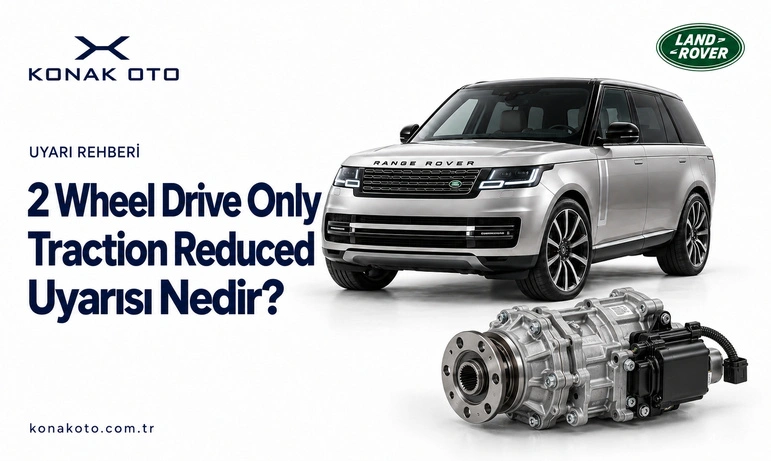
What Does the Land Rover 2 Wheel Drive Only – Traction Reduced Warning Mean and Why Does It Appear?
The 2 Wheel Drive Only – Traction Reduced warning on a Land Rover instrument panel indicates that four-wheel-drive assistance is restricted and the vehicle is limited to two-wheel-drive operation. Depending on the model and driveline equipment, the cause may involve the transfer case actuator, hydraulic pressure or fluid leakage, the coupling pump or an electronic control system.
The message itself does not identify a failed component. A correct assessment requires the vehicle model, model year, Vehicle Identification Number (VIN) and fault records from the relevant control modules to be considered together.
Quick answer: What should you know about this warning?
· AWD/4WD refers to all-wheel drive or four-wheel drive; this warning indicates that the system’s normal assistance is restricted.
· “Traction Reduced” here primarily concerns drive to the wheels and traction on the ground, rather than engine power alone.
· The message does not, by itself, establish that the automatic transmission or differential needs replacing.
· If there is noise, vibration, an oil leak or loss of drive, stop safely and contact roadside assistance.
· Even if the message disappears, a recurring concern requires the fault records to be investigated.
What does 2 Wheel Drive Only – Traction Reduced mean?
The message indicates that the vehicle cannot provide its expected four-wheel-drive capability. In particular, do not rely on normal AWD/4WD assistance on slippery surfaces, gradients, snow or off-road routes.
The message alone does not establish whether only the front or only the rear wheels are receiving drive. Driveline layouts differ between models. Systems with a transfer case are not the same as Active Driveline or Active On-Demand Coupling installations.
You can check the information relevant to your vehicle’s equipment in the Land Rover iGuide owner information using its VIN.
Why does the warning appear? Examples from manufacturer documents
The following examples show that the same or related traction warnings can have different causes. Historical technical bulletins have limited coverage. Applicability to a vehicle in Türkiye must be checked against current technical information and its VIN.
A transfer case actuator concern
JLR’s SSM74180 for the Range Rover Velar L560 links this warning to a transfer case actuator concern. Specific subcodes in the P1889 or P188E families may be stored in the relevant control module. Noise and judder during low-speed manoeuvres may accompany the warning.
For this particular fault, the document directs an actuator assessment rather than replacement of the complete transfer case. It illustrates why a major driveline assembly should not be replaced solely because the warning appears. Source: JLR SSM74180.
Hydraulic fluid leakage or a pressure concern
LTB00909NAS1 describes an internal hydraulic leak on certain Evoque and Discovery Sport vehicles equipped with Active Driveline. The concern can be associated with the traction warning and a P0942-7A record; an oil smell inside the cabin is also a reported symptom.
A separate 2025 technical briefing links the warning during low-range or off-road-mode selection on certain Range Rover, Range Rover Sport, Defender and Discovery vehicles to transfer case oil-pressure discrepancies. It discusses P1889-18 and, sometimes, P2787-4B records. Sources: LTB00909NAS1 and the SSM76315 technical briefing.
The all-wheel-drive coupling pump
LTB00843NAS1 describes a concern involving the motor brushes of the Active On-Demand Coupling oil pump on certain 2013–2014 LR2 and 2012–2015 Evoque vehicles. A P0961-62 record may accompany the warning.
The bulletin’s repair approach includes software work and a specific workshop procedure. It does not recommend the same operation or automatic pump replacement for every Evoque. Source: JLR LTB00843NAS1.
Control software or electrical connections
JLR LTB01202NAS2 addresses hardware and software incompatibility on certain covered 2017–2018 models displaying “Traction Reduced”, with U2000-4B stored in the Rear Differential Control Module. This example belongs to the same family of traction warnings; it does not mean that every affected vehicle displays the full “2 Wheel Drive Only” wording.
The related SSM73628 document also includes wiring and connector checks. Software, electrical and mechanical inspections are complementary and are selected according to the vehicle’s findings. Sources: LTB01202NAS2 and SSM73628.
What should you do when the warning appears?
Assess the driving conditions and accompanying symptoms first
Avoid sudden acceleration and sharp manoeuvres. Stop somewhere safe and check the exact message. Follow the owner information for your particular vehicle. The warning alone does not justify a universal driving distance or speed limit.
Even without another obvious symptom, do not assume that normal four-wheel-drive assistance is available. Contact a workshop to discuss how the vehicle should be transported or brought in for assessment under the conditions where it is located.
Do not continue if there is noise, vibration or loss of drive
Stop safely if there is metallic scraping or knocking, pronounced judder, an oil leak, a burning smell, an inability to move or a deterioration in vehicle control. Contact roadside assistance. The towing or recovery method must follow the vehicle’s owner information.
Do not force the system to make the message disappear
Do not take the vehicle off-road to test it or repeatedly force changes between four-wheel-drive modes. Clearing fault records before inspection or disconnecting the battery does not establish the cause. Photograph the display while parked and tell the workshop when the warning appeared.
How should a workshop diagnose the concern?
1. Record the vehicle details and complaint. Note the model, model year, equipment, mileage, service history and conditions in which the warning appears.
2. Scan the relevant control modules. Do not rely only on engine fault codes. Depending on the equipment, assess the transfer case, rear drive system and other relevant modules. Preserve records before clearing them.
3. Match the codes to the symptoms. Consider the subcode, the module that recorded it and the available operating data. A P1889 record alone does not establish that the complete transfer case has failed.
4. Carry out targeted checks. Depending on the findings, inspect leaks, hydraulic operation, actuator or pump function, connections and software level. Check bulletin applicability against the VIN.
5. Verify operation after the work. Complete any required settings or calibration, then reassess the warning, fault records and system behaviour.
Read more about this approach in our guide to Land Rover diagnostic fault detection.
What determines the repair and its cost?
The repair depends on the confirmed cause. It may involve connection repairs, appropriate software or calibration work, resolving a hydraulic leak, or repairing or replacing a component whose fault has been established. An oil change, software update or battery replacement is not a universal solution.
Driveline fluids must not be used interchangeably. The correct product and service operation are determined by the current manufacturer procedure for the particular system.
Cost depends on the diagnostic scope, necessary parts and labour, vehicle equipment and any additional damage found. A workshop should prepare a proposal based on its findings rather than quote a fixed repair price from the warning text alone.
Frequently asked questions
Is this the same as a Gearbox Fault warning?
They are different messages. This warning indicates restricted four-wheel-drive assistance. Other warnings may appear on the same vehicle; inspecting the relevant modules establishes which systems are affected.
Can I keep driving if the vehicle still moves?
The ability to move does not establish that normal AWD/4WD operation is retained. Consider the road conditions, accompanying symptoms and owner information, and contact a workshop. Do not continue if there is noise, vibration, leakage or loss of drive.
Is the problem fixed if the warning disappears after restarting?
The disappearance of the message does not prove that its cause has been resolved. Recurring warnings require the records and circumstances of the concern to be investigated.
Does the same component fail on every Land Rover?
No. Transfer case, coupling and rear drive system designs differ by model, model year and equipment. A repair carried out on another vehicle should not be applied directly to yours.
Will an oil change alone fix it?
This cannot be established before diagnosis. If the concern involves a leak, pump, actuator or control system, renewing the fluid alone may not resolve its cause.
Do I need to replace the battery?
This message alone is not a reason to replace the battery. Suspected power-supply or charging concerns require measurements; the driveline fault must also be investigated.
Land Rover traction-warning assessment in Maslak
At Konak Oto in Maslak Atatürk Auto Industry, Land Rover and Range Rover driveline complaints are assessed using vehicle findings and diagnostic records. The proposed work, parts and labour are explained based on the inspection results.
For a “2 Wheel Drive Only – Traction Reduced” warning, share your model, model year and accompanying symptoms when requesting a service appointment. If the vehicle cannot proceed safely, contact roadside assistance first.
Related articles and services
· Land Rover drivetrain service
· What is Land Rover diagnostic fault detection?
· Land Rover electronic faults: causes, symptoms and solutions
Sources
· Land Rover iGuide Online — Owner information selected by model, model year and VIN.
· JLR SSM74180, 12 March 2019 — Velar transfer case actuator and the associated traction warning.
· JLR LTB00909NAS1, 25 April 2016 — PTU internal hydraulic leakage on certain Active Driveline vehicles.
· JLR 2025 technical briefing referencing SSM76315 — Transfer case pressure discrepancies on certain 2025 model year vehicles.
· JLR LTB00843NAS1, 8 October 2015 — Coupling pump concerns and P0961-62 on certain LR2 and Evoque vehicles.
· JLR LTB01202NAS2, 21 August 2018 — Related Traction Reduced message, RDCM software and U2000-4B.
· JLR SSM73628, 9 November 2017 — Connection checks and calibration for a related warning.
Technical documents cover specific vehicles and fault conditions. The examples in this article are not a parts-replacement checklist for every Land Rover; each vehicle requires assessment using current manufacturer information.